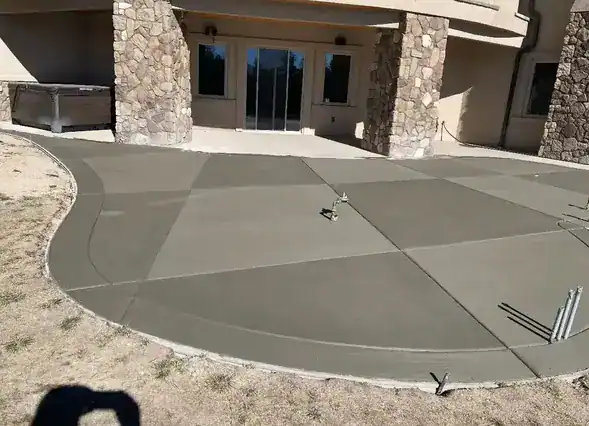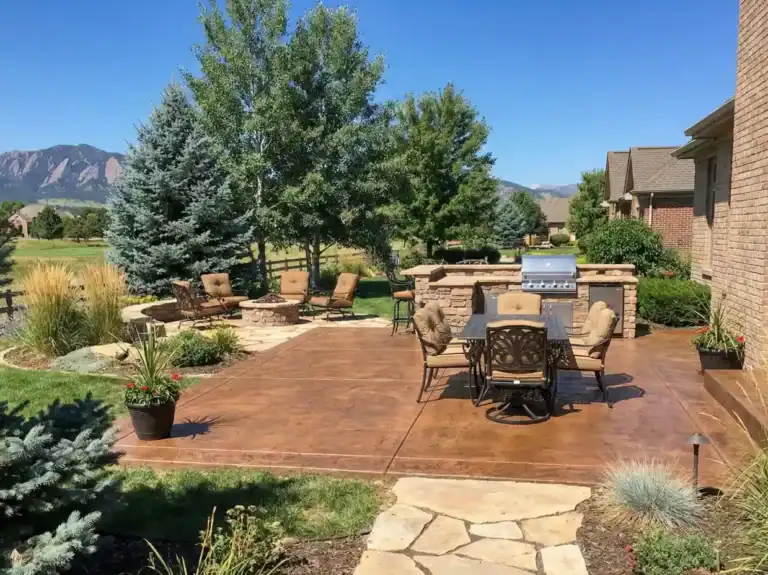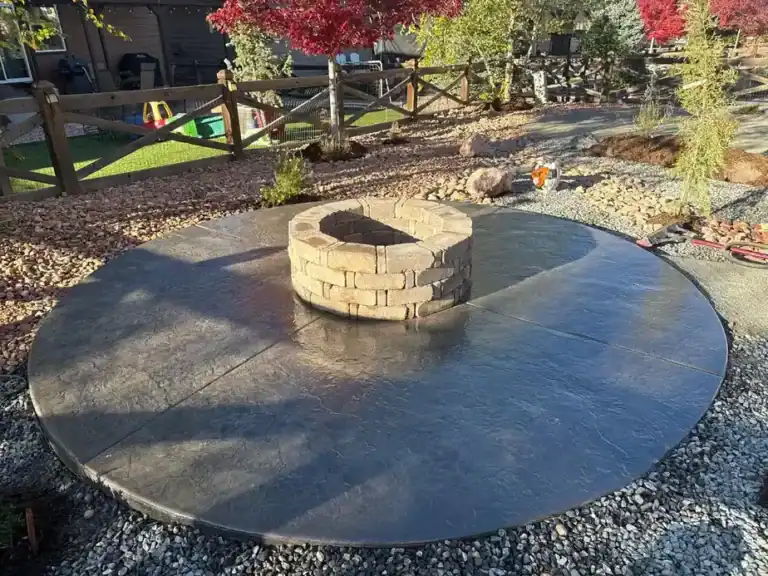
If you’re planning a new patio or driveway in Colorado, you’ve probably narrowed your options to two popular choices: stamped concrete and pavers. Both can transform your outdoor space, but they perform very differently in Colorado’s demanding climate. This guide breaks down the real differences in cost, durability, maintenance, and long-term value to help you make the right choice for your home.
Stamped concrete typically costs 20-40% less upfront and offers seamless, customizable designs. Pavers cost more initially but last longer, handle freeze-thaw cycles better, and are easier to repair. In Colorado’s climate, both can work well—but the right choice depends on your budget, timeline, and long-term plans.
Cost Comparison: Stamped Concrete vs Pavers
Let’s start with what most homeowners want to know first: how much will this cost?
Stamped Concrete Costs
Stamped concrete typically costs $8 to $20 per square foot installed, depending on the complexity of the pattern and coloring:
- Basic patterns (single color, simple texture): $8-12 per square foot
- Mid-range designs (multiple colors, standard patterns): $12-18 per square foot
- Premium designs (complex patterns, hand-applied accents, borders): $18-28+ per square foot
For a typical 400 square foot patio, expect to pay $3,200 to $8,000 for stamped concrete, with most projects falling in the $5,000-7,000 range.
Paver Costs
Pavers typically cost $10 to $35 per square foot installed, varying by material:
- Concrete pavers: $10-25 per square foot
- Brick pavers: $15-30 per square foot
- Natural stone pavers: $25-50+ per square foot
For that same 400 square foot patio, pavers will run $4,000 to $14,000, with most concrete paver projects in the $5,000-9,000 range.
Why the Price Difference?
The biggest factor is labor. Stamped concrete is poured and finished in place as a single surface—one continuous pour that’s colored and textured while still wet. Pavers, on the other hand, are laid individually by hand, piece by piece. This painstaking process requires more time, skill, and labor hours.
- Stamped concrete typically costs 20-40% less than pavers for the same area
- A 400 sq ft stamped patio: $3,200-$8,000
- A 400 sq ft paver patio: $4,000-$14,000
- Labor is the primary cost difference—pavers require more installation time
Durability and Lifespan
Both surfaces are durable, but their longevity differs significantly—especially in Colorado’s climate.
Stamped Concrete Lifespan
Properly installed and maintained stamped concrete lasts 20 to 30 years, with 25 years being typical. In Colorado’s harsher climate with extreme temperature swings, expect closer to 20-25 years.
Factors that shorten stamped concrete lifespan:
- Skipping or delaying resealing
- Using deicing salts (especially magnesium chloride)
- Poor installation (inadequate base, wrong concrete mix, improper joints)
- Heavy vehicle traffic on surfaces designed for foot traffic
Paver Lifespan
Quality pavers significantly outlast stamped concrete:
- Concrete pavers: 30-50 years
- Brick pavers: 50-100 years
- Natural stone: 50-100+ years
Concrete pavers manufactured to ASTM C936 standards must achieve a minimum compressive strength of 8,000 PSI—more than double the 3,000-4,000 PSI of standard poured concrete. This higher density makes them more resistant to wear, staining, and freeze-thaw damage.
Freeze-Thaw Performance in Colorado
This is where the two materials differ most dramatically—and where Colorado’s climate becomes a critical factor.
Denver and the Front Range experience over 150 freeze-thaw cycles per year. Each cycle allows water to penetrate surfaces, freeze, expand by 9%, and cause damage. This is the primary cause of concrete deterioration in our region.
How Stamped Concrete Handles Freeze-Thaw
Stamped concrete is a rigid, continuous slab. When water penetrates the surface and freezes, the expansion creates internal pressure that can cause:
- Surface scaling: The top layer flakes off in patches
- Spalling: Chunks break away from the surface
- Cracking: Hairline cracks grow into larger fractures
- Color damage: Surface color wears away, exposing gray concrete beneath
Proper installation mitigates these issues. Quality contractors in Colorado use:
- Air-entrained concrete (4-7% air content) that provides microscopic bubbles for ice expansion
- Higher PSI mixes (4,000+ PSI) for greater density
- Adequate control joints spaced every 8-10 feet
- Proper base preparation to prevent settling and heaving
Even with perfect installation, stamped concrete will eventually crack. It’s not a question of if, but when.
How Pavers Handle Freeze-Thaw
Pavers have a fundamental advantage: they’re designed to move. The joints between pavers allow the surface to flex with frost heave rather than crack.
According to the Interlocking Concrete Pavement Institute, concrete pavers outperform solid concrete in freeze-thaw environments because:
- Flexibility: Individual units can shift slightly without cracking
- Higher density: 8,000+ PSI limits water absorption
- Joint drainage: Water drains between pavers rather than pooling
- No continuous stress: Expansion pressure is distributed across many units
Pavers aren’t immune to freeze-thaw damage—low-quality pavers can spall, and improperly installed bases can heave. But properly installed concrete pavers meeting ASTM C936 standards perform significantly better than stamped concrete in Colorado’s climate.
If freeze-thaw durability is your top priority, pavers have a clear advantage. If budget is the primary concern and you commit to regular sealing every 2-3 years, stamped concrete can still perform well in Colorado—but expect more maintenance and a shorter lifespan.
Maintenance Requirements
Both surfaces require maintenance, but the type and frequency differ significantly.
Stamped Concrete Maintenance
Sealing is mandatory, not optional. The sealer protects both the concrete and the decorative color layer from moisture, UV damage, and wear.
- Resealing frequency: Every 2-3 years (more often for driveways or high-traffic areas)
- Resealing cost: $200-600 per application, or $1.50-3 per square foot professionally applied
- Cleaning: Regular sweeping, occasional pressure washing
- Crack monitoring: Fill hairline cracks before they grow
Using the wrong sealer—or applying it too thickly—causes problems. Stick with the same sealer type (water-based or solvent-based) used originally. Too much sealer causes whitening and peeling. A thin, even coat provides the same protection without these issues.
Paver Maintenance
Pavers require different maintenance focused on the joints between units:
- Joint sand replenishment: Every 1-3 years, or as needed when sand washes out
- Polymeric sand: Lasts 5-10 years but costs more ($200-400 for a typical patio)
- Weed prevention: Regular sweeping, polymeric sand, or optional sealing
- Sealing (optional): Every 2-5 years if you want enhanced color and stain resistance
- Resetting shifted pavers: Occasionally, if settling occurs
Important: Polymeric sand is weed-resistant, not weed-proof. Keeping organic debris (grass clippings, leaves) off the surface prevents weed seeds from taking hold.
Long-Term Maintenance Costs
Over 20 years, here’s what maintenance typically costs:
Stamped concrete (400 sq ft patio):
- Resealing every 2.5 years = 8 applications × $400 average = $3,200
- One crack repair = $200-500
- Total: $3,400-3,700
Pavers (400 sq ft patio):
- Polymeric sand reapplication (2-3 times) = $400-900
- Optional sealing (3-4 times) = $600-1,200
- Total: $400-2,100 (depending on whether you seal)
Pavers typically cost less to maintain over time, though the difference narrows if you choose to seal them regularly.
Repairs: The Biggest Difference
This is where pavers have an undeniable advantage.
Repairing Stamped Concrete
Stamped concrete repairs are challenging because:
- Color matching is difficult: Even with the original color formula, repairs rarely match perfectly due to weathering and UV exposure on the existing surface
- Pattern alignment: Matching the stamped pattern exactly is nearly impossible
- Repairs are visible: Most stamped concrete repairs remain noticeable
- Sectional replacement: If damage is extensive, you may need to replace entire sections between control joints
Crack repair costs $1-3 per linear foot, but the aesthetic result is often disappointing. As one industry expert notes: “Don’t expect an absolutely perfect match, because it just won’t happen.”
A stamped concrete driveway with significant visible cracks will hurt your home’s resale value more than a plain concrete driveway in good condition. Buyers see cracked stamped concrete as deferred maintenance.
Repairing Pavers
Paver repairs are straightforward:
- Individual replacement: Remove the damaged paver, drop in a new one
- Color matching: Easier because you’re matching manufactured units, not custom coloring
- Settling issues: Lift pavers, add base material, reset
- No visible patches: Properly matched pavers blend seamlessly
Professional paver repairs cost $7-30 per square foot, but small repairs (a few pavers) may only cost $100-300. Many homeowners handle simple paver replacements themselves.
Save extra pavers from your installation. Manufacturers occasionally discontinue colors or change formulations. Having original pavers on hand ensures perfect matches for future repairs.
Installation Time and Usability
Stamped Concrete Installation
- Installation time: 1-3 days for most residential projects
- Foot traffic: 24-48 hours after pouring
- Vehicle traffic: 7-14 days minimum (14 days recommended in Colorado)
- Full cure: 28 days
The pour itself is relatively quick, but the curing period means you can’t use your driveway for 1-2 weeks.
Paver Installation
- Installation time: 2-5 days for most residential projects (longer for complex designs)
- Foot traffic: Immediately after completion
- Vehicle traffic: Immediately after completion
Pavers take longer to install but can be used immediately—a significant advantage if you need your driveway accessible.
Design Options and Aesthetics
Stamped Concrete Design
Stamped concrete offers virtually unlimited customization:
- Patterns: Slate, flagstone, cobblestone, brick, wood plank, tile, and custom designs
- Colors: Any color achievable through integral color, color hardener, or stains
- Seamless surface: No joints or gaps (except control joints)
- Borders and accents: Combine patterns and colors in the same pour
The seamless surface is a key aesthetic advantage—no weed lines, no gaps, and a continuous pattern flow.
Paver Design
Pavers offer different design possibilities:
- Shapes: Rectangular, square, interlocking, circular, irregular
- Patterns: Herringbone, basketweave, running bond, circular patterns
- Colors: Pre-manufactured in dozens of colors; can mix and match
- Texture variety: Smooth, tumbled, textured, exposed aggregate
- Material variety: Concrete, brick, natural stone—each with unique character
Pavers have visible joints, which some homeowners prefer for a traditional look and others consider a drawback.
Safety: Slip Resistance
Stamped Concrete and Slipperiness
Stamped concrete can become slippery when wet—but it’s usually the sealer, not the concrete itself, that causes the problem. Film-forming sealers create a smooth surface that water sits on rather than draining through.
Solutions for slip resistance:
- Non-slip additives: Mix silica sand, polymer beads, or products like “Shark Grip” into the sealer
- Penetrating sealers: These soak in rather than forming a film, maintaining natural texture
- Textured patterns: Deeper stamp patterns provide more traction than shallow textures
- Thin sealer application: Less sealer means less slipperiness
For pool surrounds or areas that stay wet, discuss slip-resistance options with your contractor before installation. Non-slip additives should be standard for these applications.
Paver Slip Resistance
Pavers are naturally more slip-resistant because:
- Textured surfaces provide inherent traction
- Joints between pavers help channel water away
- No film-forming sealer required (sealing is optional)
For pool decks and wet areas, pavers generally provide better traction without requiring additives.
Home Value and ROI
Both options add value to your home, but the return differs.
Stamped Concrete ROI
A well-maintained stamped concrete patio can add up to 15% to your home’s value according to industry studies, with an ROI of 80-100%. However, this assumes the surface is in good condition. Cracked or faded stamped concrete actually detracts from value because buyers see it as an expensive repair.
Paver ROI
Pavers are generally perceived as a more premium feature by homebuyers. Because they last longer and are easier to repair, they maintain their value better over time. Real estate professionals note that paver driveways and patios can help homes sell faster due to enhanced curb appeal.
The key insight: A well-maintained stamped concrete surface adds value. A poorly maintained one—with visible cracks and faded color—hurts value. Pavers are more forgiving because individual repairs don’t stand out.
Which Is Better for Colorado?
There’s no universal “better” choice—it depends on your priorities.
Budget Is Primary Concern
Stamped concrete typically costs 20-40% less upfront. If you’re working with a fixed budget, it delivers more decorative impact per dollar.
You Want a Seamless Look
The continuous, grout-free surface of stamped concrete appeals to homeowners who dislike the “busy” look of individual paver joints.
You'll Commit to Maintenance
Stamped concrete performs well in Colorado when properly sealed every 2-3 years. If you’ll stay on top of maintenance, it’s a viable choice.
Shorter Timeline
Planning to sell or move within 10-15 years? Stamped concrete’s lifespan may outlast your ownership, making the lower upfront cost more attractive.
Longevity Matters Most
If you’re in your forever home and want a surface that lasts 40-50+ years with minimal worry, pavers are the better investment.
You Want Easy Repairs
Pavers can be individually replaced without visible patches. If repairability concerns you, pavers provide peace of mind.
Freeze-Thaw Is a Major Concern
For areas with significant frost exposure—north-facing driveways, shaded patios—pavers handle Colorado’s 150+ annual freeze-thaw cycles better.
Immediate Use Required
Need to use your driveway right away? Pavers allow immediate vehicle traffic; stamped concrete requires 7-14 days of curing.
What About Combining Both?
Some homeowners get the best of both worlds by combining materials:
- Stamped concrete driveway with paver border: Lower cost for the main surface with premium accents
- Paver patio with stamped concrete walkways: Premium entertaining space with budget-friendly pathways
- Stamped concrete pool deck with paver coping: Cost savings on the large area with easy-to-repair edges
This hybrid approach lets you allocate budget strategically—spending more where it matters most.
Questions to Ask Your Contractor
Whether you choose stamped concrete or pavers, ask these questions:
- What base preparation will you do? (Critical for both materials in Colorado)
- For stamped concrete: Will you use air-entrained concrete? What PSI?
- For pavers: Do your pavers meet ASTM C936 standards?
- What’s included in your warranty, and for how long?
- What maintenance will be required, and what’s the cost?
- Can you show me local projects that are 5+ years old?
- How do you handle drainage to prevent water pooling?
- Stamped concrete costs $8-20/sq ft vs $10-35/sq ft for pavers—stamped is typically 20-40% cheaper
- Pavers last 30-50+ years; stamped concrete lasts 20-30 years
- Pavers handle Colorado’s 150+ freeze-thaw cycles better due to flexibility and higher PSI
- Stamped concrete repairs are difficult to match; paver repairs blend seamlessly
- Stamped concrete requires resealing every 2-3 years; pavers need periodic joint sand replacement
- Both add home value, but cracked stamped concrete hurts value more than worn pavers
- Consider combining both materials for budget optimization
Ready to Decide?
Both stamped concrete and pavers can create beautiful, functional outdoor spaces in Colorado. The right choice depends on your budget, how long you plan to stay in your home, your tolerance for maintenance, and your aesthetic preferences.
If you’re still unsure, seeing examples in person helps. Look at stamped concrete and paver installations in your neighborhood that are several years old. How are they holding up? That real-world evidence often makes the decision clear.
Get Expert Advice for Your Project
Request Free ConsultationRelated: Stamped Concrete Services | Concrete Patios | Concrete Driveways