Concrete patio or wood deck? It’s one of the biggest outdoor living decisions Colorado homeowners face, and the answer isn’t as simple as the internet makes it seem. Both create usable backyard space, but they perform very differently in our high-altitude climate, they cost different amounts to build and maintain, and one of them comes with a fire safety advantage that matters more every year along the Front Range. This guide breaks down the real differences in cost, durability, maintenance, and long-term value.
For ground-level outdoor space, a concrete patio costs less than a comparable deck, lasts as long or longer (25-30+ years), and needs a fraction of the maintenance. In Colorado’s climate, with intense UV, very dry air, and growing wildfire risk, concrete’s advantages get bigger. Wood decks make sense in specific situations: elevated back doors, steep slopes, and second-story access. For a backyard at or near grade, concrete is the better investment for most Front Range homeowners.
Upfront Cost: Concrete Patio vs Wood Deck
Concrete Patio Cost
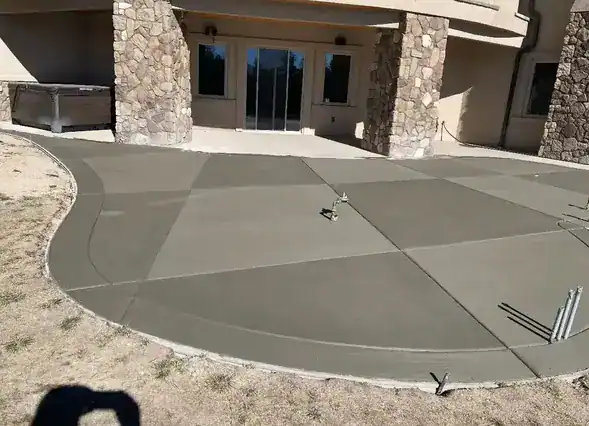
A plain broom-finish concrete patio in Colorado Springs runs about $20 per square foot installed at a typical patio size (large pours drop to $12-15), which includes grading, forming, 4,000 PSI air-entrained concrete, fiber rebar reinforcement, and finishing. A 400 square foot patio is roughly $8,000. Stamped concrete costs considerably more, commonly 1.25 to 2 times the plain price, and is quoted per project. We price all projects at a $6,500 minimum.
Wood Deck Cost
A deck costs more because you’re building an elevated structure, not just a surface: footings, posts, beams, joists, decking, railings, and stairs. Zonda’s 2024 Cost vs. Value Report puts a 16×20 pressure-treated wood deck at about $17,600 nationally and a composite deck at about $24,200, roughly $55 and $75 per square foot with railings and stairs included. A simple ground-hugging deck can come in below that, but even the budget end of deck pricing lands at or above a plain concrete patio, and cedar or composite runs two to three times more.
Deck quotes often exclude railings, stairs, permits, and demolition of an existing structure, which can add thousands. A concrete patio quote should include everything: grading, reinforcement, the pour, finishing, and sealer on decorative finishes.
Lifespan and Maintenance in Colorado
National lifespan estimates don’t account for Colorado’s combination of intense UV, very dry air, and big temperature swings. Wood suffers most.
- Concrete patio: 25-30 years, often longer, when built with 4,000 PSI air-entrained concrete and fiber rebar. Maintenance is a rinse or pressure wash as needed. Stamped and colored finishes get resealed every 2-3 years to protect the color. Plain grey concrete doesn’t need a sealer at all; we tell our customers not to buy one.
- Pressure-treated wood deck: 10-15 years here, versus 15-20 nationally. Colorado’s sun and dry air gray, split, and check the boards fast. Expect to stain or seal every 1-2 years, replace warped and split boards starting around year 5-7, tighten popped fasteners as the wood shrinks, and inspect joists, posts, and the ledger connection every year.
- Cedar deck: 15-20 years with diligent maintenance. Its natural oils resist rot, but UV breaks those oils down faster at altitude.
- Composite deck: 25-30 years and little surface maintenance. The catch is the price, and the framing under it is still wood.
Over the life of a concrete patio, a pressure-treated deck will typically need a full replacement plus a decade of staining. That’s the real cost gap, and it’s larger than the upfront one.
How Colorado’s Climate Affects Each Material
- UV at altitude. Sunlight at 6,000+ feet is noticeably stronger than at sea level. It breaks down wood fibers, dries out natural oils, and shortens the life of every coat of stain. Concrete has no organic fibers to break down; UV lightens the surface slightly over decades and that’s about it.
- Dry air. Deck boards shrink, gap, and split at the end grain. Fasteners loosen as the wood around them shrinks. Concrete, once cured, doesn’t care.
- Freeze-thaw. Colorado Springs sees well over 100 freeze-thaw cycles a year. Water in wood grain freezes, expands, and splits the fibers. Air-entrained concrete has microscopic bubbles that give ice room to expand, which is why the mix matters more than anything else on a Colorado slab.
Fire Safety: A Growing Colorado Concern
Most patio-versus-deck comparisons skip this, and it matters more every year along the Front Range. The Waldo Canyon and Black Forest fires hit close to Colorado Springs, and many neighborhoods near the foothills, Black Forest, and Monument sit in or near the Wildland-Urban Interface. Colorado adopted a statewide wildfire resiliency code in 2025, and local rules in those areas increasingly push toward noncombustible materials close to the house.
Concrete doesn’t burn. A concrete patio is defensible space, not fuel. Before investing in a wood deck near the foothills, check with the Pikes Peak Regional Building Department on what your zone allows; fire-rated decking, where required, pushes deck costs even higher.
Design: Where Each One Wins
Decks win on elevated space. If your back door sits well above grade, a deck gives you a level walk-out, plus railings, stairs, and storage underneath. Wood also has a warmth people like, at least until it grays.
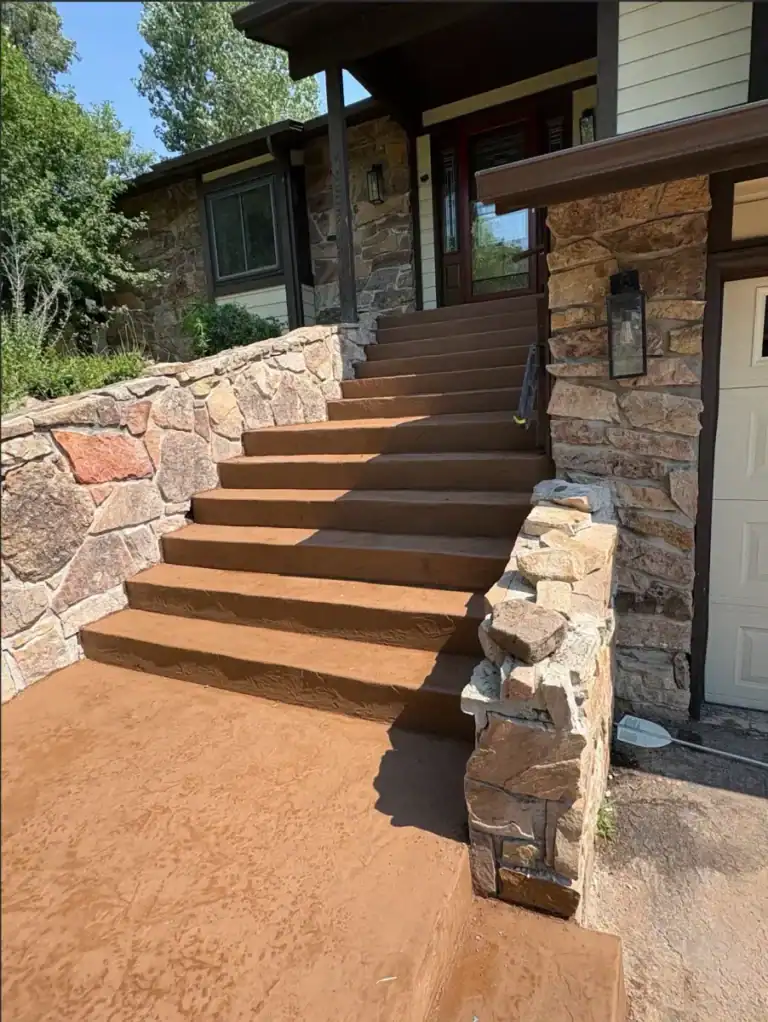
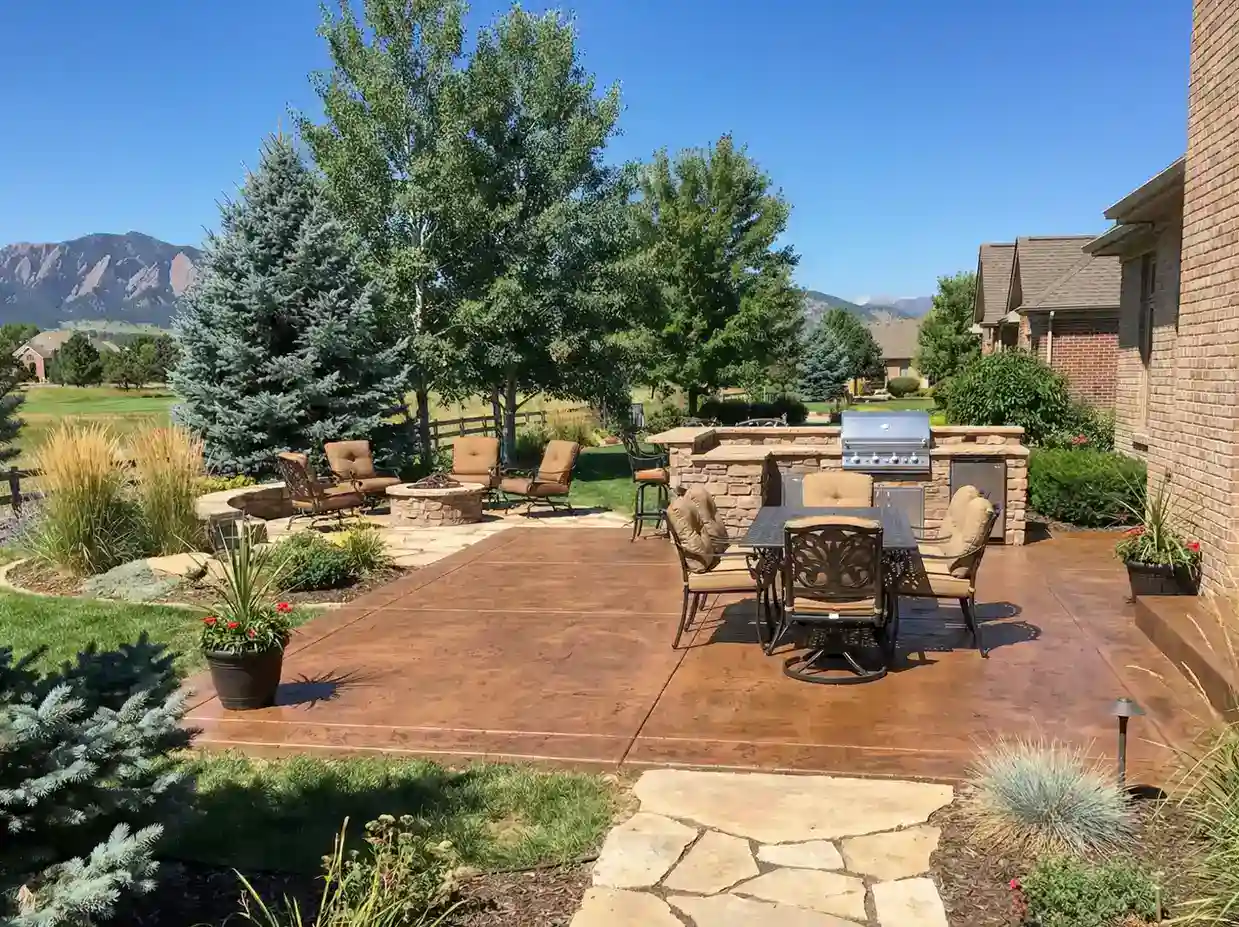
Concrete wins on versatility and livability at ground level. Stamped patterns like ashlar slate and roman slate, integral color, and decorative borders give more design options than lumber does. The surface is seamless, so there are no gaps, splinters, or raised screws, and heavy furniture, grills, fire pits, and hot tubs sit stable on it. Step off the patio and you’re in the yard, with no stairs in between.
Resale Value
Both add value, but a patio holds its value with less effort. The National Association of Realtors’ 2023 Remodeling Impact Report puts cost recovery on a new patio at about 95%. Zonda’s 2024 Cost vs. Value Report puts a pressure-treated deck at about 83% and a composite deck at about 68%. Those deck numbers also assume the deck is in good shape at sale. In Colorado, a 10-year-old wood deck often looks like it needs replacing, and buyers price that in. A 10-year-old concrete patio still has 15-20 years left and looks like a feature, not a future expense.
When a Wood Deck Makes Sense
We pour concrete patios, so we’re biased. But a deck is genuinely the right call when:
- Your back door is elevated. If the main floor is 3+ feet above the yard, common with walkout basements, a deck gives a level transition that a ground-level patio can’t without a lot of grading, retaining walls, or steps.
- Your lot is steep. A deck can cantilever over a grade change where a patio would need major fill or retaining work.
- You want second-story access. Concrete can’t do that.
When a Concrete Patio Is the Better Investment
- Your yard is at or near grade. There’s no structural reason to build an elevated deck, and concrete gives you the same usable space for less money and almost no upkeep.
- You want low maintenance. Resealing a decorative finish every 2-3 years is the only recurring task, and plain grey needs nothing.
- You’re in or near a fire zone. Noncombustible isn’t a nice-to-have there; it may be the rule.
- You plan to stay. One concrete patio covers your whole time in the house. A wood deck needs at least one full rebuild in that span.
What About Composite?
Composite decking (Trex, TimberTech, Fiberon) fixes most of wood’s problems: no staining, no splitting, good UV resistance. If you need a deck, composite is the better deck for Colorado. But it doesn’t change the patio-versus-deck math. It still sits on wood framing, still needs railings, stairs, and permits, and its installed cost is two to three times a plain concrete patio. At ground level, concrete gives you more square footage and more design options for less money.
The Bottom Line for Colorado Homeowners
For ground-level outdoor living, which is what most Colorado Springs homeowners are building, a concrete patio is the smarter investment by almost every measure. It costs less to build, lasts as long or longer, needs a fraction of the maintenance, handles Colorado’s UV and freeze-thaw better, and doesn’t burn. Decks earn their place on elevated entries, steep lots, and upper floors. Everywhere else, the math favors concrete.
- Plain concrete patio: about $20/sq ft installed; stamped considerably more. Wood and composite decks start around the same price and go up to 2-3x
- Concrete lasts 25-30+ years; pressure-treated decks last 10-15 in Colorado and need staining every 1-2 years
- Colorado’s UV, dry air, and 100+ freeze-thaw cycles a year are hard on wood and easy on air-entrained concrete
- Concrete is noncombustible and counts as defensible space in fire-prone areas
- Patios recover about 95% of cost at resale (NAR 2023); wood decks about 83%, composite about 68% (Zonda 2024)
- Choose a deck for elevated doors, steep slopes, or second-story access; choose concrete for everything at grade
Get a Free Concrete Patio Estimate
Request Free QuoteRelated: Concrete Patio Services | Concrete Patio Cost Guide | Concrete Patio Ideas for Colorado