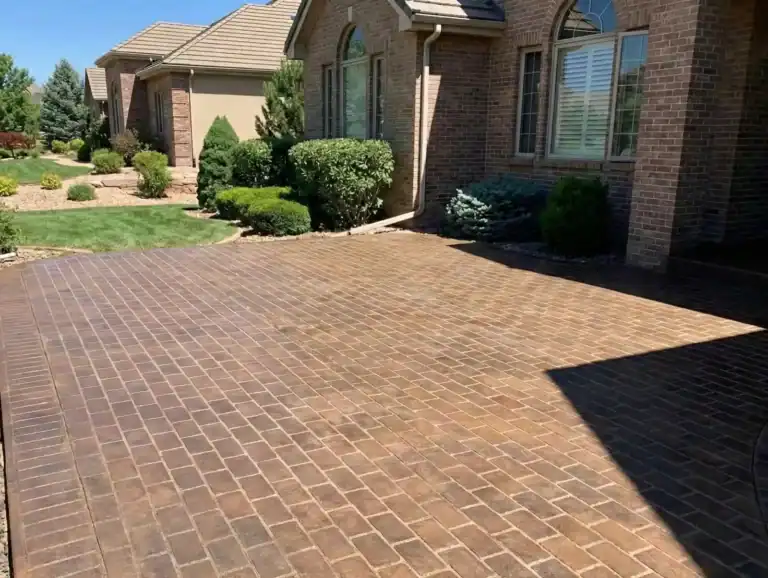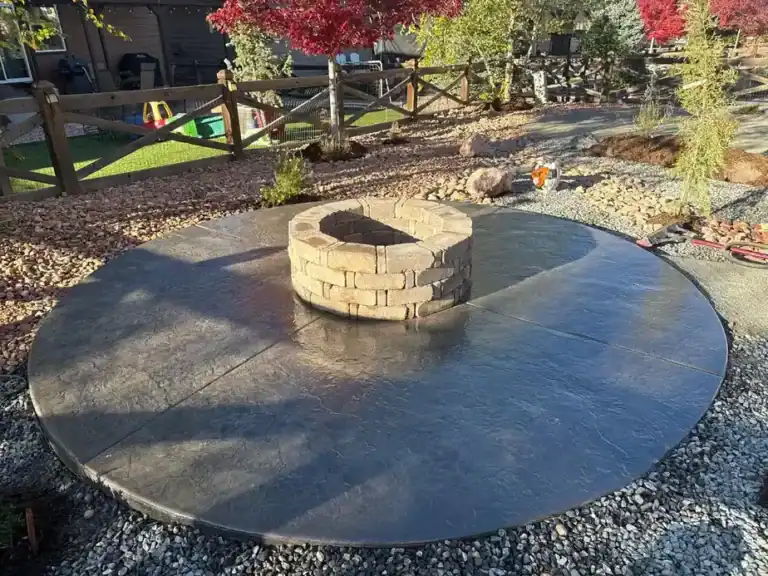
Stamped concrete is one of the most popular ways to upgrade a driveway, patio, or walkway in Colorado Springs. It gives you the look of natural stone, brick, or slate at a fraction of the cost — and it holds up to our tough Front Range climate when installed correctly. Whether you’re planning a new patio or replacing an aging driveway, this guide covers everything Colorado Springs homeowners need to know about stamped concrete: patterns, colors, costs, maintenance, and what to expect during installation.
Stamped concrete combines durability with design flexibility. You get a surface that handles our freeze-thaw cycles, expansive clay soils, and intense UV exposure — while looking like materials that cost two to three times more.
What Is Stamped Concrete?
Stamped concrete is freshly poured concrete that’s textured and colored to resemble stone, brick, wood, tile, or other materials. After the concrete is poured and leveled, contractors press large rubber mats (stamps) into the surface before it sets. A combination of integral color and surface-applied release agent creates realistic depth, texture, and color variation.
The result is a seamless, durable surface that mimics premium materials without the maintenance headaches of individual pavers or natural stone. There are no joints for weeds to grow through, no stones to shift or settle unevenly, and no grout lines to crack.
Popular Stamped Concrete Patterns in Colorado Springs
Pattern choice is one of the biggest decisions you’ll make. The right pattern should complement your home’s architecture, landscaping, and the overall feel you’re going for. Here are the most popular patterns we see across Colorado Springs neighborhoods.
Ashlar Slate
The most requested pattern in Colorado Springs. Ashlar slate features a combination of rectangular shapes in varying sizes, creating a natural stone look that works with everything from modern homes in Briargate to ranch-style properties in Security-Widefield. It’s versatile, timeless, and photographs well from any angle.
Random Stone (Flagstone)
Random stone mimics the look of natural flagstone with irregular, organic shapes. This pattern is especially popular for patios and pool decks because it creates a relaxed, natural feel. It pairs well with Colorado landscaping — rock gardens, native grasses, and mountain views.
Herringbone Brick
A classic choice for driveways, herringbone brick creates a traditional, formal appearance. The interlocking V-pattern is visually striking and makes driveways look wider. This pattern is common in established neighborhoods like Broadmoor and Old North End.
European Fan
Also called cobblestone fan, this pattern replicates the look of old-world European streets. It’s a premium choice that adds serious curb appeal to driveways and front walkways. The curved, radiating pattern creates visual interest that basic rectangles can’t match.
Wood Plank
Wood plank stamping has surged in popularity for patios. It gives you the warm look of a wood deck without the constant staining, sealing, and board replacement that Colorado’s dry climate and UV exposure demand. You get the aesthetic without the upkeep.
- Ashlar slate and random stone are the safest choices — they complement almost any home style
- Brick patterns work best for driveways and front walkways
- Wood plank is ideal for patios where you want a deck look without deck maintenance
- Ask your contractor to show you completed projects with your preferred pattern before committing
Stamped Concrete Colors That Work in Colorado
Color is the other half of the equation. Stamped concrete uses two color methods together: integral color mixed throughout the concrete, and a contrasting release agent applied to the surface before stamping. The combination creates the realistic depth and variation you see in natural materials.
Most Popular Color Combinations
In Colorado Springs, earth tones dominate. They blend with our natural landscape — Pikes Peak, red rock formations, and the high desert palette that defines the Front Range.
- Desert tan with dark brown release — The most popular combination locally. Warm, neutral, and works with any exterior color.
- Pewter gray with charcoal release — A modern, clean look that pairs well with contemporary architecture and gray stone landscaping.
- Sandstone with brown release — Mimics natural Colorado sandstone. Especially popular for patios that blend with rock features.
- Terra cotta with dark walnut release — A warmer option that complements brick, stucco, and southwestern-style homes common in Colorado Springs.
- Slate gray with black release — Bold and dramatic. Works well with modern homes and provides strong contrast.
Lighter colors reflect more UV and stay cooler underfoot in our intense high-altitude sun — an important consideration for patios and pool decks. Darker colors show less dirt but absorb more heat. Most homeowners find that medium earth tones strike the best balance.
Integral Color Options
Integral color is mixed directly into the concrete before pouring, so the color runs all the way through. This means small chips or surface wear won’t expose plain gray concrete underneath. Major color manufacturers like Davis Colors and Solomon Colors offer dozens of options ranging from subtle tans to deep reds and charcoals.
Your contractor should provide color samples or point you to a color chart so you can see how the pigment looks in actual cured concrete — not just on a screen. Colors always look different in person, and Colorado’s bright sunlight affects appearance significantly.
How Much Does Stamped Concrete Cost in Colorado Springs?
Cost is usually the first question homeowners ask, and the answer depends on the scope of the project. Here’s what to expect in the Colorado Springs market as of 2026.
Cost Breakdown by Project Type
Stamped concrete patios typically run $12 to $18 per square foot installed, depending on the pattern complexity and color choices. A typical 400-square-foot backyard patio costs between $4,800 and $7,200. More intricate patterns like European fan or multi-color work push toward the higher end.
Stamped concrete driveways range from $13 to $20 per square foot. Driveways require thicker concrete (typically 5-6 inches vs. 4 inches for patios) and heavier reinforcement to support vehicle traffic, which adds to the cost. A standard two-car driveway (400-600 square feet) runs $5,200 to $12,000.
Stamped concrete walkways are usually the most affordable project at $12 to $16 per square foot, since they’re smaller in scope and use standard 4-inch thickness.
What Affects the Price
- Pattern complexity — Simple patterns (ashlar, brick) cost less than intricate ones (European fan, custom borders)
- Number of colors — Single integral color costs less than two-tone or multi-color work
- Project size — Larger projects have a lower per-square-foot cost due to economies of scale
- Site preparation — Removing old concrete (R&R), grading, or dealing with drainage adds cost
- Thickness and reinforcement — Driveways need more material and rebar than patios
- Access — Backyard projects that require wheelbarrow or pump delivery cost more than front driveways with truck access
Standard broom-finish concrete in Colorado Springs runs roughly $8 to $14 per square foot installed. Stamped concrete adds approximately $3 to $6 per square foot for the color and stamping work. You’re paying a modest premium for a dramatically different look.
Stamped Concrete vs. Natural Stone Cost
Natural flagstone patios in Colorado Springs typically cost $25 to $45 per square foot installed. Paver driveways run $20 to $35 per square foot. Stamped concrete delivers a similar look for roughly 40-60% less — and without the ongoing maintenance of resetting shifted pavers or re-leveling settled flagstone.
Stamped Concrete Maintenance in Colorado
One of the biggest advantages of stamped concrete is low maintenance compared to alternatives. But “low maintenance” doesn’t mean “no maintenance,” especially in Colorado’s demanding climate. Here’s what’s involved in keeping stamped concrete looking great for decades.
Sealing: The Most Important Step
Sealing is the single most important maintenance task for stamped concrete. A quality acrylic sealer protects the color from UV fading, prevents moisture from penetrating the surface, and enhances the color depth. In Colorado Springs, you should reseal stamped concrete every 2-3 years.
The easiest test: splash water on the surface. If it soaks in instead of beading up, it’s time to reseal. In Colorado Springs, most stamped concrete needs resealing every 2-3 years due to our intense UV exposure and freeze-thaw cycles.
Never use salt or chemical deicers on stamped concrete. They accelerate freeze-thaw damage and can discolor the surface. Use sand for traction in winter instead. Deicer damage is not covered under concrete warranties.
Clean stamped concrete with a garden hose or pressure washer on a low setting (under 1,500 PSI). Avoid harsh chemicals. For stubborn stains, use a pH-neutral concrete cleaner. Aggressive pressure washing can strip the sealer and damage the surface texture.
Seasonal Care for Colorado
Colorado’s climate creates specific maintenance challenges:
- Spring: Inspect for any winter damage. Clean off accumulated grit and debris. This is the best time to reseal if needed.
- Summer: UV exposure is intense at our altitude. A good sealer with UV inhibitors prevents fading.
- Fall: Clear leaves promptly — wet leaves can stain the surface. Apply sealer before first freeze if due.
- Winter: Remove snow with a plastic shovel (not metal). Use sand for traction, never salt or chemical deicers.
How Long Does Stamped Concrete Last?
Properly installed and maintained stamped concrete lasts 25-30 years or more in Colorado Springs. The concrete itself is as durable as any standard slab — it’s the same 4,000 PSI mix with rebar reinforcement. The stamped texture and color are integral to the concrete, not a surface coating that wears off.
The sealer is what needs periodic renewal, not the concrete itself. Think of it like staining a deck — the structure lasts decades, you just refresh the protective finish every few years.
Stamped Concrete Installation: What to Expect
Understanding the installation process helps you plan your project and know what to look for in quality workmanship. Here’s what a typical stamped concrete project looks like from start to finish.
Site Preparation
The old surface is removed (if replacing), the area is excavated to the proper depth, and a compacted gravel base is established. Proper base preparation is critical in Colorado Springs due to our expansive clay soils — skipping this step is the number one cause of premature cracking and settling.
Forming and Reinforcement
Wooden or metal forms are set to define the shape and edges. Steel rebar is placed in a grid pattern for reinforcement. In Colorado Springs, #4 rebar at 24-inch spacing is standard due to our soil conditions. Control joints are planned to manage where the concrete will naturally crack.
Pouring and Coloring
Concrete is poured with integral color already mixed in. The surface is leveled and smoothed. A colored release agent (powder or liquid) is applied to the surface — this prevents the stamps from sticking and adds the secondary color that creates depth and contrast.
Stamping
Large rubber stamp mats are pressed into the concrete while it’s still workable. Timing is critical — the concrete needs to be firm enough to hold the pattern but soft enough to take the impression. This is where experience matters most. The stamps are carefully aligned to create a seamless, natural-looking pattern.
Detail Work and Curing
Edges are hand-detailed, and any imperfections are touched up. The release agent is washed off after curing, revealing the final two-tone color effect. The concrete cures for a minimum of 7 days (ideally 14 in Colorado’s dry climate) before a protective sealer is applied. Full strength develops over 28 days.
Timeline
Most residential stamped concrete projects in Colorado Springs take 2-4 days of on-site work, depending on size. Add 7-14 days of curing time before the surface is sealed. You can typically walk on stamped concrete after 24-48 hours, but keep vehicles off driveways for at least 7 days.
Stamped Concrete vs. Other Options
Wondering how stamped concrete stacks up against other popular materials? Here’s a quick comparison for Colorado Springs homeowners.
Stamped Concrete vs. Pavers
- Cost: Stamped concrete is typically 20-30% less expensive than quality pavers
- Maintenance: Pavers can shift, settle, and allow weed growth between joints. Stamped concrete is one continuous surface.
- Durability: Both last 25+ years. Pavers can be individually replaced; stamped concrete repairs are harder to match perfectly.
- Appearance: Pavers offer more texture variation. Stamped concrete provides a seamless look.
Stamped Concrete vs. Plain Concrete
- Cost: Stamped adds roughly $3-6 per square foot over plain concrete
- Appearance: Night and day difference. Stamped concrete transforms a utilitarian surface into a design feature.
- Resale value: Stamped concrete patios and driveways add more perceived value to your home
- Maintenance: Stamped concrete requires periodic resealing; plain concrete is more forgiving
Stamped Concrete vs. Natural Stone
- Cost: Natural stone costs 2-3x more than stamped concrete
- Durability: Both are extremely durable. Natural stone can crack or shift individually.
- Maintenance: Natural stone requires joint maintenance and weed control. Stamped concrete just needs periodic sealing.
- Authenticity: Natural stone is the real thing. High-quality stamped concrete comes very close but isn’t identical up close.
Common Stamped Concrete Questions
Will stamped concrete crack?
All concrete can develop hairline cracks over time — it’s a natural characteristic of the material. Proper installation with adequate base preparation, reinforcement, and control joints minimizes cracking significantly. In Colorado Springs, working with a contractor who understands our expansive clay soils is especially important. Hairline cracks are cosmetic and don’t affect the structural integrity of the slab.
Can you stamp existing concrete?
You cannot stamp concrete that has already cured. However, existing concrete can be resurfaced with a stampable overlay — a thin layer of modified concrete applied over the existing slab and then stamped. Overlays work best when the existing concrete is structurally sound with no major cracking or settling.
Is stamped concrete slippery?
The stamped texture actually provides more traction than smooth-finished concrete. However, a heavy coat of sealer can make the surface slick when wet. A non-slip additive can be mixed into the sealer for pool decks, walkways, or any area that gets wet frequently. Most residential stamped concrete is not noticeably slippery with normal sealer application.
What’s the best time of year for stamped concrete in Colorado Springs?
Late spring through early fall (May through October) is ideal. Concrete needs consistent temperatures above 50 degrees F to cure properly, and Colorado Springs’ dry climate actually helps the curing process. Avoid pouring during extreme heat (above 90 degrees F) or when freezing temperatures are in the forecast within 7 days.
Can stamped concrete be repaired?
Minor surface repairs are possible, though matching the existing color and pattern perfectly can be challenging. This is why proper installation matters so much upfront. Structural issues like major cracking or settling may require removing and replacing the affected section. Working with an experienced contractor from the start is the best way to avoid repair needs.
Ready for a Stamped Concrete Project?
Get Your Free EstimateCreststone Concrete serves homeowners throughout Colorado Springs, Monument, Castle Rock, Parker, Lone Tree, and the I-25 corridor with quality concrete driveways, patios, walkways, and decorative concrete. Call (719) 631-2660 or request a free estimate online.