Asphalt or concrete? It’s the first decision most Colorado Springs homeowners face when replacing a driveway. Both materials are proven, widely used, and available from local contractors. But they perform very differently in Colorado’s climate — and the cost gap between them isn’t as wide as you might think once you look at the full picture. This guide breaks down the real differences in cost, durability, maintenance, and long-term value so you can make the right call for your home.
Asphalt costs less upfront ($7-13/sq ft vs $8-20/sq ft for concrete), but concrete lasts roughly twice as long (30-40 years vs 15-20 years). In Colorado’s high-altitude climate with intense UV, extreme temperature swings, and expansive clay soils, concrete’s durability advantage is even more pronounced. Over 30 years, concrete typically costs less total because you avoid a full replacement cycle.
Upfront Cost: Asphalt vs Concrete Driveway
Asphalt’s lower price tag is its biggest selling point — and it’s real. Here’s what each material costs installed in 2026:
Asphalt Driveway Cost
A new asphalt driveway runs $7 to $13 per square foot installed, with most residential projects averaging around $8-10 per square foot. For a standard two-car driveway (400-600 sq ft), that’s $3,500 to $7,000.
Concrete Driveway Cost
A quality concrete driveway in Colorado Springs costs $8 to $20 per square foot depending on the finish — broom finish on the lower end, stamped or decorative on the higher end. For the same two-car driveway, expect $4,000 to $12,000.
The Real Gap
Comparing apples to apples — a plain broom-finish concrete driveway ($8-12/sq ft) against standard asphalt ($7-13/sq ft) — the upfront difference is only $500 to $2,000 on a typical driveway. That’s a smaller gap than most people expect. The cost spread widens if you choose decorative concrete finishes like stamped or colored, but for a standard driveway the initial investment is surprisingly close.
Lifespan: This Is Where the Math Changes
If both materials lasted the same amount of time, asphalt would be the clear budget winner. But they don’t.
- Asphalt lifespan: 15-20 years with regular maintenance. On Colorado’s clay soils, closer to 15-18 years is realistic.
- Concrete lifespan: 30-40 years when properly installed. With Colorado-appropriate thickness, reinforcement, and base preparation, 30+ years is standard.
Michigan Department of Transportation data backs this up: across thousands of road miles, concrete pavement lasts an average of 27.5 years before needing major repairs, while asphalt averages just 15.5 years. Federal highway studies show concrete lasts roughly 2.5 times longer than asphalt on average.
What does that mean for your driveway? If you’re planning to stay in your home for 20+ years, an asphalt driveway will need to be completely replaced at least once. A concrete driveway won’t.
A 500 sq ft asphalt driveway installed today for $5,000 will likely need full replacement in 15-18 years — another $5,000-$8,000 (accounting for inflation and removal costs). That $5,000 “savings” over concrete disappears and then some. Over 30 years, asphalt typically costs $14,000 to $20,000+ while concrete costs $6,500 to $12,000 total.
How Colorado’s Climate Affects Each Material
National cost guides don’t account for our specific challenges. Colorado Springs sits at 6,035 feet with intense UV, dramatic temperature swings, and notoriously difficult soils. Each of these factors hits asphalt harder than concrete.
UV Damage at Altitude
UV radiation increases roughly 2% for every 1,000 feet of elevation. At Colorado Springs’ altitude, UV is 12-20% more intense than at sea level. This is the single biggest threat to asphalt driveways in Colorado.
Asphalt is a petroleum-based product. UV radiation breaks down the oil binders that keep it flexible and waterproof — a process called photo-oxidation. The result:
- Asphalt turns gray and brittle within 2-3 years without sealcoating
- The surface develops “alligator cracking” — a network of interconnected cracks that looks exactly like it sounds
- Research confirms that intense UV creates “gradient aging” — a hard, brittle surface layer over a softer sublayer, which accelerates cracking from the top down
Concrete doesn’t have oil binders to break down. UV causes minor surface fading over decades, but it doesn’t compromise the material’s structural integrity. This is why concrete driveways in Colorado still look good after 20 years while asphalt driveways often look worn after 5.
Local paving contractors in Colorado cite UV degradation as the #1 reason asphalt driveways fail prematurely along the Front Range. The same UV intensity that gives us 300 days of sunshine accelerates asphalt aging far beyond what national maintenance guides account for.
Temperature Swings and Freeze-Thaw
Colorado Springs regularly sees 30-40 degree temperature swings in a single day — warm afternoons dropping below freezing overnight, sometimes within hours. This constant thermal cycling stresses both materials, but in different ways.
Asphalt: The expansion and contraction from daily temperature swings fatigues asphalt year-round, not just in winter. Combined with UV-induced brittleness, this creates cracks that water infiltrates. When that water freezes, it expands and widens the cracks — the classic freeze-thaw damage cycle. Local contractors identify this as the #1 cause of asphalt failure in Colorado.
Concrete: Properly installed concrete handles freeze-thaw well because contractors here use air-entrained concrete (tiny air bubbles that give ice room to expand) and 4,000+ PSI mixes. Strategically placed control joints allow the slab to move without random cracking. Concrete isn’t immune to freeze-thaw, but it’s engineered to handle it.
Summer Heat
Here’s something most homeowners don’t consider: asphalt softens in heat. On a sunny Colorado summer day, asphalt surface temperatures can exceed 140 degrees F. The binder literally becomes pliable.
The result is rutting — permanent depressions that form in your wheel paths from repeatedly parking on softened asphalt. Once ruts form, they collect water, which accelerates further damage. You’ll notice this on any older asphalt driveway in Colorado Springs: two parallel grooves running from the street to the garage.
Concrete doesn’t soften in heat. A concrete driveway looks the same after a 95-degree day as it did before.
Expansive Clay Soils
Colorado’s Front Range contains some of the most problematic expansive soils in the country. Our clay-heavy soil swells when wet and shrinks when dry, creating a heaving and settling cycle that stresses any surface above it.
Asphalt’s advantage here: Its flexibility allows it to bend with moderate soil movement rather than crack. This is a legitimate point in asphalt’s favor.
Concrete’s response: Quality contractors compensate with deeper base preparation (4-6 inches of compacted gravel), proper reinforcement (#4 rebar on 24-inch centers), and control joints that let the slab move in a controlled way. These measures add cost upfront but prevent the catastrophic cracking that poorly installed concrete can suffer.
On Colorado’s clay soils, asphalt’s flexibility is a genuine advantage — but it’s a short-term one. That same flexibility means asphalt deforms permanently under load (rutting) and doesn’t bounce back from settlement the way a reinforced concrete slab can.
- UV at altitude degrades asphalt 12-20% faster than at sea level
- Daily 30-40 degree temperature swings fatigue asphalt year-round
- Asphalt softens in summer heat, causing permanent rutting in wheel paths
- Concrete handles UV, heat, and freeze-thaw better when properly installed for Colorado conditions
- Asphalt has a slight edge on clay soils due to flexibility, but the advantage is short-lived
Maintenance: What Each Material Demands
Both driveways need maintenance. But asphalt needs significantly more, and it needs it more often — especially in Colorado.
Asphalt Maintenance Schedule
- Sealcoating: Every 2-3 years in Colorado ($250-$770 per application). This is not optional here — without it, UV will destroy the surface within a few years. National guides say every 3-5 years, but Colorado’s UV intensity demands a shorter cycle.
- Crack filling: Annually before winter ($100-$400 depending on severity). Every crack that isn’t sealed before the first freeze becomes a bigger crack by spring.
- Resurfacing (overlay): Typically needed at year 10-15 ($3-7/sq ft). This buys you another 8-10 years before full replacement.
- Full replacement: At year 15-20 on Colorado clay soils.
Concrete Maintenance Schedule
- Sealing: Every 3-5 years (optional but recommended, $1.50-3/sq ft professionally applied). Protects against staining and moisture penetration.
- Crack monitoring: Fill any cracks that develop before winter. With proper installation, this is minimal.
- Joint maintenance: Keep control joints clear of debris so they can function properly.
- No resurfacing or replacement needed within the 30-40 year lifespan.
20-Year Maintenance Cost Comparison
For a typical 500 sq ft driveway over 20 years:
Asphalt:
- Sealcoating (7-8 applications): $1,750-$5,400
- Annual crack repairs: $1,000-$4,000
- One resurfacing at ~year 12: $1,500-$3,500
- Total maintenance: $4,250-$12,900
Concrete:
- Sealing (4-5 applications): $1,200-$3,000
- Occasional crack repair: $200-$500
- Total maintenance: $1,400-$3,500
That’s a $3,000 to $9,000 difference in maintenance costs alone over 20 years — before you even account for asphalt’s shorter lifespan and eventual replacement.
The 30-Year Cost Comparison
This is the number that matters. Here’s what each material actually costs over 30 years when you include installation, maintenance, and replacement:
| Cost Category | Asphalt | Concrete |
|---|---|---|
| Initial Install (500 sq ft) | $3,500-$6,500 | $4,000-$10,000 |
| Maintenance (30 yrs) | $5,000-$14,000 | $2,000-$5,000 |
| Replacement at ~yr 17 | $5,000-$9,000 | Not needed |
| 30-Year Total | $13,500-$29,500 | $6,000-$15,000 |
| Lifespan | 15-20 years | 30-40 years |
| Design Options | Black only | Colors, stamps, aggregate, broom |
Concrete costs roughly half as much as asphalt over 30 years. The upfront savings from asphalt are consumed by higher maintenance demands and the inevitable full replacement at year 15-20.
Appearance and Curb Appeal
This one’s straightforward.
Asphalt comes in one color: black. It fades to gray within a few years (faster in Colorado’s UV). Sealcoating temporarily restores the dark color, but it’s an ongoing battle. There are no pattern, texture, or color options.
Concrete offers multiple finish options that hold up for decades:
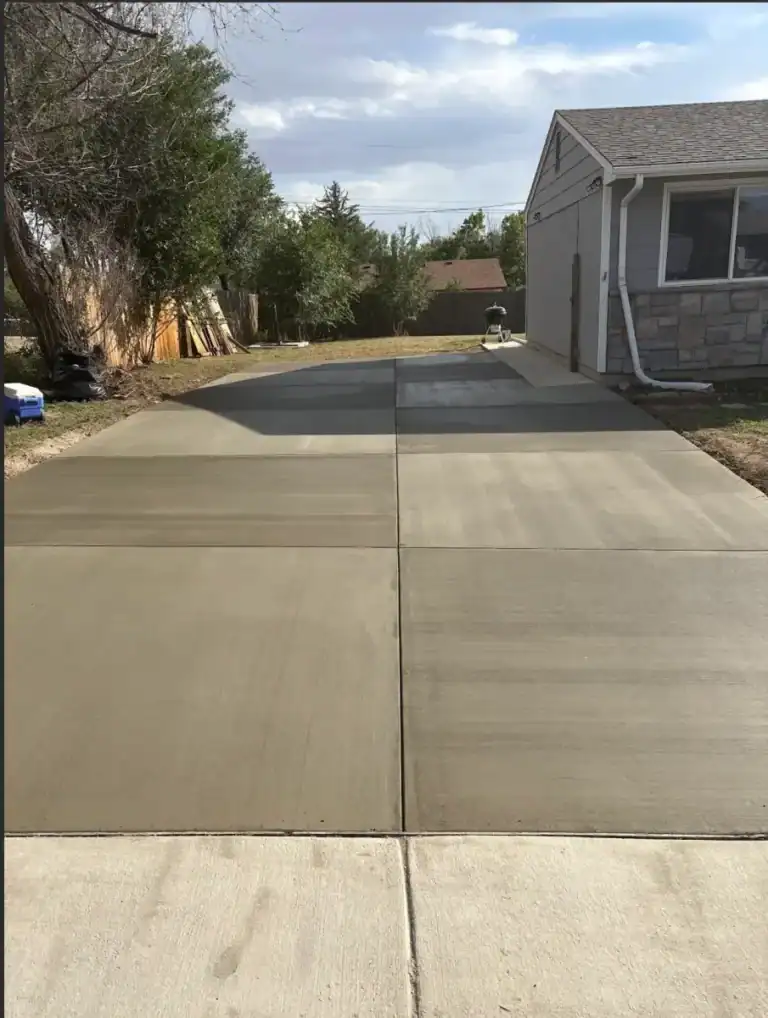
- Broom finish: Clean, classic look with excellent traction
- Colored concrete: Integral color mixed throughout — won’t fade or wear away
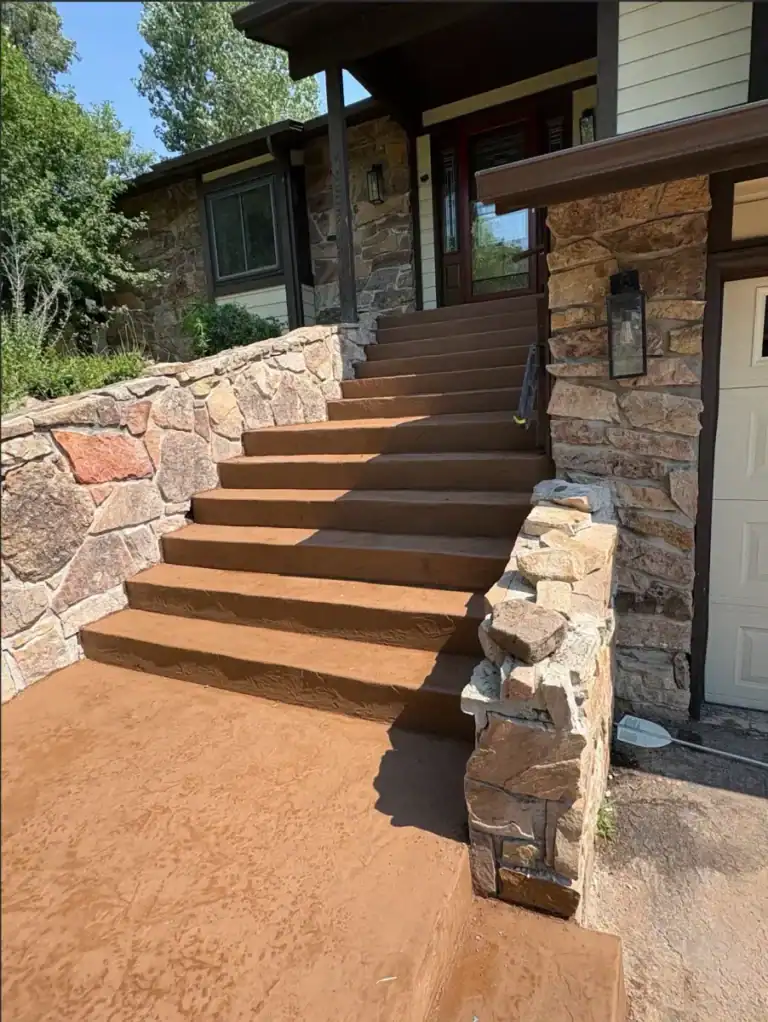
- Stamped concrete: Mimics stone, brick, or slate at a fraction of the cost
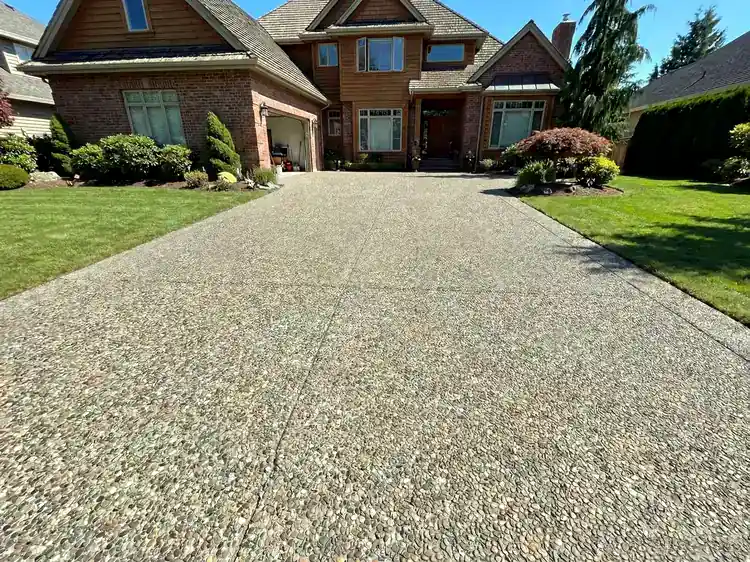
- Exposed aggregate: Reveals natural stone for a textured, decorative surface
In Colorado Springs neighborhoods where curb appeal drives home values, the design flexibility of concrete is a significant advantage. A stamped concrete driveway makes a statement. An asphalt driveway is just… there.
Resale Value
Both materials add value over gravel or a deteriorating surface, but concrete has the edge:
- New driveways generally yield a 50-75% return on investment at resale
- Real estate professionals consistently rate concrete as the higher-value driveway material because of its longer remaining useful life and design options
- In Colorado Springs specifically, most newer subdivisions and higher-end homes have concrete driveways — it’s the expected standard. Asphalt is more common in rural areas and older neighborhoods
- A well-maintained concrete driveway still has 15-20 years of life left when you sell after 15 years. An asphalt driveway at 15 years is approaching end-of-life — a liability, not a selling point
A crumbling asphalt driveway signals “deferred maintenance” to homebuyers and inspectors. If you’re planning to sell within 5-10 years, investing in a concrete driveway now gives you a selling feature. Investing in asphalt now gives you something buyers will want to replace.
When Asphalt Actually Makes Sense
We install concrete driveways, so we’re obviously biased. But honesty matters more than a sale, and there are situations where asphalt is the smarter choice:
You're Selling Soon
If you’re selling the home within 3-5 years and the current driveway is in bad shape, asphalt’s lower upfront cost gets you a fresh, clean surface that checks the “paved driveway” box for buyers without the higher concrete investment.
It's a Long, Rural Driveway
For driveways over 1,000 square feet — especially long rural driveways — the per-square-foot savings of asphalt add up to thousands of dollars. At that scale, the budget difference is harder to justify.
You Need Quick Access
Asphalt can handle vehicle traffic within 2-3 days of installation. Concrete needs 7-14 days of curing before you can drive on it. If driveway downtime is a problem, asphalt gets you back to normal faster.
Budget Is the Only Priority
If the absolute lowest upfront cost is all that matters and you’re comfortable with the higher maintenance and shorter lifespan, asphalt delivers the cheapest day-one price.
When Concrete Is the Better Investment
You Plan to Stay 10+ Years
Concrete’s 30-40 year lifespan means one installation covers your entire time in the home. With asphalt, you’ll face a full replacement at year 15-20 — an expense that erases the upfront savings and then some.
You Want Low Maintenance
Sealing a concrete driveway every 3-5 years is the only significant maintenance task. Compare that to asphalt’s cycle of sealcoating every 2-3 years, annual crack repair, and eventual resurfacing. If you’d rather not think about your driveway, concrete is the answer.
Curb Appeal Matters
Concrete offers colors, patterns, and textures that complement your home’s architecture. In Colorado Springs’ competitive real estate market, a decorative concrete driveway differentiates your home. Asphalt looks the same on every house.
You're in a Typical Colorado Springs Neighborhood
Most newer developments and established neighborhoods in the Springs have concrete driveways. Matching the neighborhood standard protects your home’s value and avoids standing out for the wrong reason.
What About Asphalt Overlay on Old Concrete?
Some homeowners consider putting asphalt over an existing concrete driveway to save on demolition costs. This is almost always a bad idea:
- The concrete slab underneath will continue to crack and shift, and those cracks will telegraph through the asphalt overlay within 1-3 years
- Different expansion rates between the two materials cause delamination — the asphalt separates from the concrete
- It creates drainage issues by raising the driveway surface above the garage floor
- Most reputable contractors won’t do it because they know it will fail
If your old concrete is failing, the right move is to remove it and install a new surface — whether that’s concrete or asphalt. Layering one over the other creates a problem you’ll be paying to fix again in a few years.
Environmental Considerations
For homeowners who factor environmental impact into their decisions:
- Asphalt is petroleum-based and its production involves oil refining, though it uses a byproduct rather than refined fuel
- Concrete production is carbon-intensive — cement manufacturing is one of the largest industrial CO2 sources
- Asphalt absorbs more heat, contributing to the urban heat island effect (surface temps can reach 140+ degrees F). Concrete’s lighter color reflects more sunlight and stays cooler
- Asphalt is highly recyclable — old asphalt can be milled and reused in new pavement. This is a genuine environmental advantage
- Concrete’s longer lifespan means fewer replacements and less total material consumed over time — one concrete driveway vs two asphalt driveways over 30 years
Neither material is clearly “greener.” Asphalt wins on recyclability; concrete wins on longevity and heat reduction.
The Bottom Line for Colorado Springs Homeowners
Asphalt is cheaper on day one. Concrete is cheaper over the life of your home. In Colorado’s specific climate — with intense UV at altitude, daily temperature swings, hot summers, and challenging soils — concrete’s advantages are amplified and asphalt’s weaknesses are accelerated.
For most Colorado Springs homeowners planning to stay in their home for more than a few years, a concrete driveway is the better investment. You pay a little more upfront, but you get a surface that lasts twice as long, needs a fraction of the maintenance, offers real design options, and adds more to your home’s value.
- Asphalt costs $7-13/sq ft installed; concrete costs $8-20/sq ft — the gap narrows for standard finishes
- Concrete lasts 30-40 years vs 15-20 for asphalt — roughly twice the lifespan
- Colorado’s UV is 12-20% stronger at altitude, degrading asphalt faster than national averages suggest
- Asphalt needs sealcoating every 2-3 years + annual crack repair + resurfacing at year 10-15
- Over 30 years, concrete costs roughly half as much as asphalt ($6K-15K vs $13K-30K)
- Asphalt softens in summer heat and develops permanent ruts — concrete doesn’t
- Concrete offers colors, stamps, and textures; asphalt is black only
- Most Colorado Springs neighborhoods have concrete driveways — it’s the local standard
- Asphalt makes sense for short-term ownership, long rural driveways, or tight budgets
Get a Free Concrete Driveway Estimate
Request Free QuoteRelated: Concrete Driveway Services | Concrete Driveway Cost Guide | Repair or Replace Your Driveway?