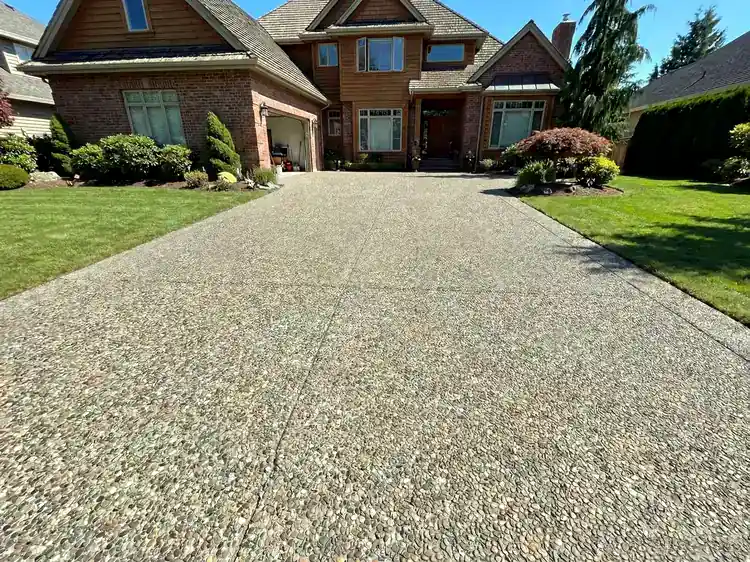
Exposed aggregate concrete gives you the look of natural stone with the strength of a poured slab. It’s a decorative finish you’ll see on driveways, patios, and walkways across Colorado Springs and the Front Range. This short guide covers what exposed aggregate is, how it’s made, what it costs compared to stamped and broom-finish concrete, and how it holds up in Colorado’s freeze-thaw climate.
Exposed aggregate is a concrete finish where the top layer of cement paste is washed away after the pour to reveal the stone (aggregate) underneath. Every concrete mix contains gravel or crushed stone, but in a standard pour it’s hidden beneath a broom finish. With exposed aggregate, the stone becomes the surface, giving a textured, slip-resistant, natural-looking finish.
How Exposed Aggregate Concrete Is Made
The slab is poured like any other, usually with a decorative stone selected for the mix. Before the surface hardens, the crew sprays a surface retarder that slows the set of the top layer of cement paste. Within hours, the paste is washed off with water and a stiff brush, exposing the stone. Once cured, the surface is sealed to lock in the stone and deepen its color.
The hard part is timing. Wash too early and you lose stone; wash too late and the paste won’t come off. Colorado’s dry air, sun, and wind shrink that window, which is why exposed aggregate needs an experienced crew and a careful plan for the day of the pour.
Exposed Aggregate Cost in Colorado Springs
Exposed aggregate is the most expensive standard finish, more than stamped concrete. Plain broom-finish concrete in Colorado Springs runs about $20 per square foot on a typical project. Stamped costs considerably more, and exposed aggregate costs more still, because of the decorative stone, the retarder and sealer, and the labor of washing and finishing on a tight timeline. Every exposed aggregate project is quoted individually. See our concrete driveway cost guide for the full pricing picture.
Exposed Aggregate vs. Stamped Concrete
- Look: Stamped concrete imitates flagstone, slate, brick, or wood plank. Exposed aggregate looks like what it is: natural stone set in concrete.
- Traction: Exposed aggregate has a naturally textured, slip-resistant surface. Stamped concrete is smoother and needs a grip additive in the sealer around pools and on slopes.
- Cost: Both are premium finishes. Exposed aggregate is the more expensive of the two.
- Maintenance: Both are sealed after the pour and resealed every 2-3 years.
For most Colorado Springs homeowners who want a decorative driveway or patio, stamped concrete is the more common choice. Exposed aggregate is worth considering where traction matters most or where you want a natural stone look without a pattern.
Does Exposed Aggregate Hold Up in Colorado Winters?
Yes, when it’s built right. The structural slab is identical to any other quality pour: 4,000 PSI air-entrained concrete with fiber rebar reinforcement. Air entrainment is what survives Colorado’s freeze-thaw cycles, well over 100 a year. The exposed stone itself is durable and doesn’t fade in UV the way surface coatings can. The one vulnerability is deicer: salt and magnesium chloride attack the cement paste that holds the stone, so use sand for traction instead.
Sealing and Maintaining Exposed Aggregate
- Seal after the pour and reseal every 2-3 years to protect the paste around the stone.
- No deicers. Sand only for winter traction.
- Rinse and sweep to keep grit from wearing the sealer.
- Clean spills quickly. Oil and automotive fluids stain the paste if left overnight.
Exposed Aggregate FAQ
How long does exposed aggregate concrete last?
As long as any quality concrete slab: 25-30+ years in Colorado when the mix is air-entrained, the reinforcement is right, and the sealer is maintained.
Is exposed aggregate more expensive than stamped concrete?
Yes. Exposed aggregate is the most expensive standard concrete finish, above stamped and well above plain broom finish.
Does exposed aggregate hurt bare feet?
It depends on the stone. Small, rounded pea gravel is comfortable underfoot. Larger or crushed angular stone can feel rough, so patios and pool decks should use smaller, rounded aggregate.
Thinking About a Decorative Concrete Finish?
Request Your Free QuoteThinking About a Decorative Concrete Finish?
Request Your Free QuoteRelated: Stamped & Decorative Concrete Services | Stamped Concrete Guide | Concrete Driveway Cost Guide | Project Gallery