The driveway apron is the most overlooked and most abused section of any driveway. It’s the concrete panel between the street and the start of your main driveway, sitting in the public right-of-way. If you’ve noticed cracks, sinking, or crumbling at the bottom of your driveway where it meets the road, that’s your apron failing. This guide covers what a concrete driveway apron is, why it fails before the rest of the driveway, what replacement costs in Colorado Springs, and when to replace just the apron versus the whole driveway.
A driveway apron is the concrete transition between the public street and your private driveway. The City of Colorado Springs requires it to be 6 inches thick, because it carries garbage and delivery trucks that a 4-inch driveway slab was never designed for. Aprons crack first because of those loads, the water that runs along the curb, and the deicer that concentrates there. Apron-only replacement is a small pour, so contractor project minimums usually apply (ours is $6,500); it’s most often done together with other concrete work or as part of a full driveway replacement.
What Is a Concrete Driveway Apron?
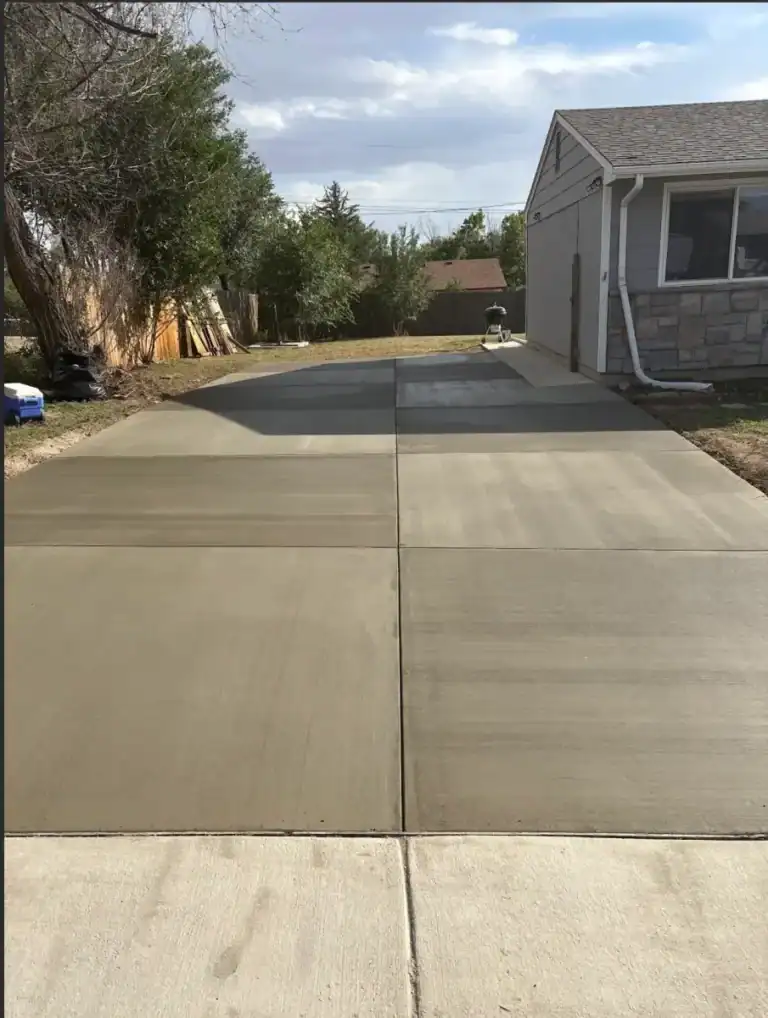
Your driveway apron is the section of concrete that connects your driveway to the street. It sits within the public right-of-way, the strip of land between your property line and the road, even though you’re responsible for maintaining it. It’s typically the width of your driveway and runs 6-10 feet from the curb, with a rolled or beveled curb transition at the street edge.
The apron does two jobs. It gives vehicles a smooth ramp between the street and your driveway elevation, and it manages stormwater along the curb and gutter, directing runoff past your driveway rather than into it.
In Colorado Springs, the apron sits in the city right-of-way but is the homeowner’s responsibility to maintain and replace. The city sets the specifications (thickness, mix, grade, curb profile) and requires a right-of-way permit before work starts. The city does not pay for residential apron replacement.
Why Driveway Aprons Crack First
Truck Loads
A 4-inch residential slab is designed for cars and light SUVs. A loaded garbage or delivery truck puts 8,000 to 10,000 pounds on a single wheel, and that wheel crosses the apron every week, often at an angle as the truck swings in toward the curb. That’s the engineering reason the city requires 6 inches at the apron, and it’s why 4-inch driveways crack at the street end and stay fine at the garage.
Water and Deicer
The apron sits at the low point of the driveway, right in the gutter’s path. Summer downpours run along and under its edges, winter snowmelt puts it through a freeze-thaw cycle nearly every day, plows push ice against its face, and the city’s road deicer concentrates exactly where it sits. Water running under the edge of a slab washes out the support beneath it, and that’s where sinking and cracking begin.
Built Too Thin
Many older driveways in Colorado Springs were poured with 4-inch aprons, the same as the main slab. If your home predates the current right-of-way standard, your apron was probably under-built from day one.
Signs Your Driveway Apron Needs Replacement
A single hairline crack along a control joint is normal. These aren’t:
- It has sunk below the street. A lip you feel driving in means the support underneath has washed out and the slab has settled. It’s a trip hazard, it scrapes low vehicles, and it traps water against the curb.
- Multiple cracks in different directions. A spiderweb pattern, especially with pieces that rock when you step on them, means the slab has broken into independent pieces. Patching won’t hold.
- Spalling. The surface flaking away in chunks. In Colorado this is almost always deicer plus freeze-thaw, and it accelerates once it starts.
- It has heaved. A hump in the apron usually means water collecting and freezing underneath. The drainage has to be fixed during replacement or the new apron will do the same thing.
A quick test: push on different sections with your foot. If any piece moves independently from the rest, it’s replacement territory.
Driveway Apron Replacement Cost in Colorado Springs
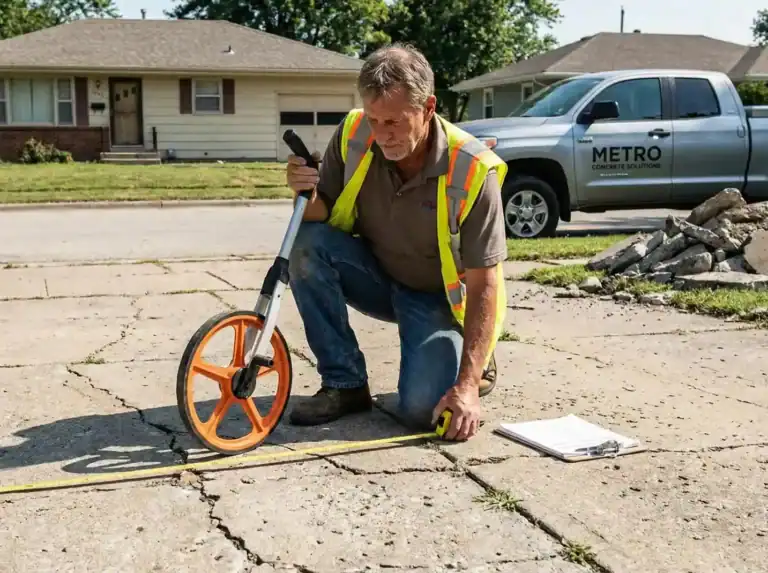
Concrete is priced by the square foot, about $20 for plain broom finish on a typical project, plus roughly $2 per square foot for tear-out. An apron is 6 inches thick instead of 4, so it uses half again as much concrete per square foot. The catch is size: a typical apron is only 80-160 square feet, and mobilization, the crew’s day, forms, the permit, and disposal cost about the same whether you pour 100 square feet or 500. That’s why most contractors, including us, have a project minimum. Ours is $6,500.
In practice, apron replacement happens one of three ways:
- As part of a full driveway replacement. The most common, and the cleanest result.
- Combined with other concrete work. A walkway, patio, or steps poured the same day shares the setup and gets the apron in under the minimum.
- Apron only. Possible, but expect the project minimum to apply. Damaged curb and gutter, if it has to be poured with the apron, adds to the cost.
Apron Only vs Full Driveway Replacement
If the rest of your driveway is in good shape, a new apron joined to it with a proper expansion joint will serve for 25-30+ years. Consider replacing the full driveway instead if the main slab is also cracking or settling, if the driveway is 25+ years old, or if you’re already paying for demolition and a crew day. The marginal cost of extending the work is far less than coming back for the driveway later.
Colorado Springs Permit and Specifications
Because the apron is in the public right-of-way, you can’t tear it out and pour a new one without city approval. A right-of-way work permit is required before any excavation, and the city’s concrete standard sets the specification: 6-inch thickness, the city’s 4,000 PSI air-entrained exterior mix, subgrade compacted with any soft material removed and replaced with compacted fill, a curing compound on the finished surface, and the curb profile. The city may inspect before the pour and after. A reputable local contractor pulls the permit as part of the job. If a contractor suggests skipping it, that’s a red flag; unpermitted right-of-way work can be ordered torn out at your expense.
What Proper Apron Installation Looks Like
- Prepared subgrade. The old apron comes out, the ground is graded to slope toward the street (so water leaves your driveway rather than pooling at the garage) and compacted. Soft or washed-out material is dug out and replaced with compacted fill, per the city spec. No gravel layer is needed on sound native ground; gravel is used only to regrade.
- 6-inch thickness. Non-negotiable at the apron.
- 4,000 PSI air-entrained concrete. Air entrainment gives freezing water room to expand without breaking the slab, which matters most at the apron where the deicer lands.
- Fiber rebar in a tied grid. Composite bars that can’t rust, so the road salt sitting on the apron all winter can’t corrode the reinforcement. Bars don’t prevent cracks; they hold a crack tight so the slab stays in one piece.
- Joints. An expansion joint against the existing driveway and against the curb, and control joints cut the same day as the pour.
- Broom finish. Broom texture for traction on the steepest part of the driveway, and no vehicles for at least 7 days.
Apron Replacement Timeline
- Permit: Pulled by your contractor before any work starts.
- Day one: Saw-cut, break out, and haul off the old apron. Grade and compact the subgrade. Set forms to the correct grade and curb profile, and tie the rebar grid.
- Day two: Pour, screed, finish, cut control joints.
- Curing: Foot traffic after 24-48 hours, no vehicles for 7 days, longer in cool weather.
Two days of crew work, then a week of curing. The pouring season in Colorado Springs runs May through October; see our guide to the best time to pour concrete in Colorado.
The Bottom Line
Your driveway apron takes more abuse than any other part of your driveway: the heaviest loads, the most water, and the most deicer, all concentrated on one small slab. When it fails, a properly built 6-inch apron on a compacted subgrade will last 25-30+ years. If the rest of the driveway is showing its age too, it’s usually smarter to replace the whole driveway at once: one crew day and one permit.
- The apron is the concrete panel between your driveway and the street, in the public right-of-way, and it’s your responsibility
- Aprons fail first because of truck wheel loads, water along the curb, and deicer
- The City of Colorado Springs requires a 6-inch apron, 4,000 PSI air-entrained concrete, and a right-of-way permit
- Apron-only replacement is a small pour; project minimums apply (ours is $6,500), so it’s usually combined with other work or a full driveway replacement
- Replace the apron if it’s sunk, heaved, spalling, or broken into pieces that move
- Consider full driveway replacement if the main slab is also 25+ years old or damaged
Get a Free Driveway Estimate
Request Free QuoteRelated: Concrete Driveway Services | Concrete Driveway Cost Guide | Repair or Replace Your Driveway? | Best Time to Pour Concrete in Colorado