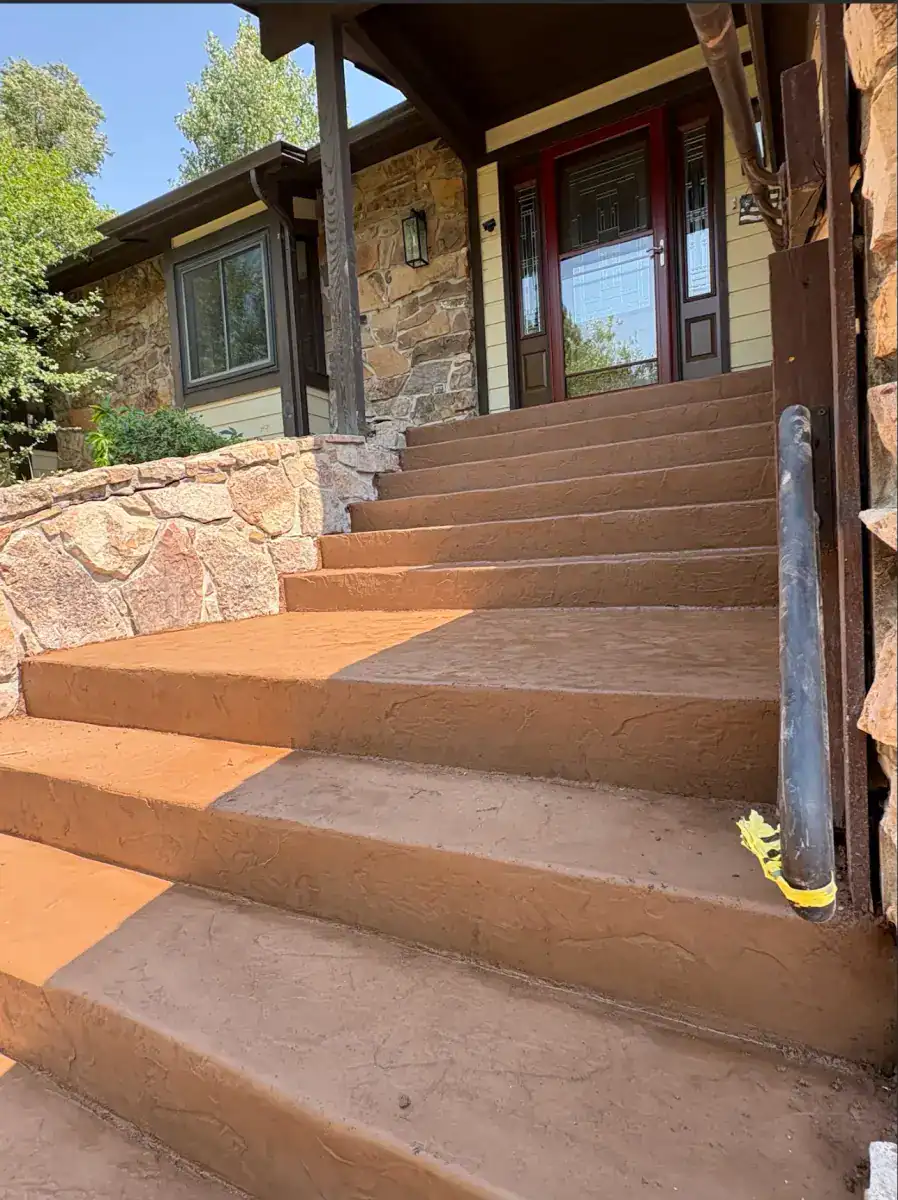
Whether you’re replacing crumbling front entry steps, adding a new set off the back deck, or building a path of steps down a sloped yard, concrete steps cost in Colorado Springs varies more than most homeowners expect. A small entry set can run $1,200 while a larger porch-to-yard staircase can push past $8,000 — and the difference isn’t always just “number of steps.” This guide breaks down exactly what concrete steps cost in Colorado Springs, what drives pricing up or down, the Colorado-specific factors that affect your quote, and real example projects so you can budget accurately before calling a concrete contractor.
Concrete steps cost in Colorado Springs typically runs $400 to $700 per step for a standard broom-finish set at 4 feet wide, or $600 to $1,100 per step for stamped and decorative finishes. Most residential projects fall in these total ranges: small entry steps (2-3 risers) $1,200-$2,500, medium sets (4-5 risers) $2,500-$4,500, larger staircases (6-8 risers) $4,500-$8,000. Integrated retaining walls, custom handrails, and premium decorative finishes can push a project past $10,000. Colorado pricing runs modestly higher than national averages because our frost line (36 inches), expansive clay soil, and freeze-thaw climate require deeper footings, 4,000 PSI air-entrained concrete, and proper base preparation that shortcut-bidders skip.
What Goes Into the Cost of Concrete Steps?
Before you can tell whether a bid is reasonable, you need to understand what you’re actually paying for. “Pouring concrete steps” sounds simple but involves eight distinct phases of work, each with real cost implications.
The Materials Breakdown
For a typical 4-step entry staircase at 4 feet wide, the material list looks roughly like this:
- Concrete — Approximately 1 to 1.5 cubic yards of 4,000 PSI air-entrained mix at $180-$240 per yard delivered, plus short-load fees for deliveries under 3 yards ($75-$150 typical)
- Rebar — #4 reinforcement on 12-inch grid patterns through treads and risers, plus dowels tying into existing concrete or footings
- Formwork lumber — Dimensional lumber for step forms, stakes, braces; typically used once and discarded
- Base material — Class 6 road base for compacted sub-base under steps that aren’t tied directly to an existing foundation
- Footing concrete — Additional concrete for frost-depth footings on freestanding or tall step structures
- Curing compound — Applied to every exposed surface to prevent rapid drying in Colorado’s arid climate
The Labor Reality
Concrete steps cost significantly more per square foot than flat slab work, and the reason is labor. A 400-square-foot driveway pours in a continuous flow with one screed pass and one set of finishing tools. A 4-step staircase of the same concrete volume requires:
- Individual formwork for each riser, set to exact IRC dimensions (maximum 7-3/4″ riser, minimum 10″ tread)
- Hand-placing concrete stair by stair so it doesn’t collapse the lower forms
- Hand-finishing every tread surface and riser face individually
- Tooled edges at every transition for durability
- Removing forms after initial cure without damaging the fresh concrete beneath
A skilled two-person crew spends roughly 1.5 to 2 full days on a standard residential step installation, not counting demolition or handrail work. That’s why concrete steps cost much more per cubic yard installed than a flat slab the same crew could finish in half a day — the labor-to-material ratio is three to four times higher. This is also why quoting steps “per square foot” is misleading and most reputable Colorado Springs contractors quote by the project or by the step.
Concrete Steps Cost by Project Size
For budgeting purposes, here’s what most Colorado Springs homeowners actually pay for residential concrete step projects at standard width (3-4 feet) with a broom finish:
| Project Size | Typical Use | Cost Range |
|---|---|---|
| Small (2-3 steps) | Front entry, back door, garage service door | $1,200-$2,500 |
| Medium (4-5 steps) | Raised porch access, elevated entry, basement walk-out | $2,500-$4,500 |
| Large (6-8 steps) | Deck-to-yard, walk-out basement, tall porch | $4,500-$8,000 |
| Extra-large (9+ steps) | Sloped lots, multi-level yards, integrated retaining | $8,000-$15,000+ |
| Decorative upgrade | Stamped, colored, or exposed aggregate | Add 20-60% to base |
| Handrail add-on | Required at 4+ risers (IRC code) | $500-$3,000+ |
A rule of thumb: smaller step projects cost more per step because mobilization, delivery minimums, and setup time are fixed costs spread across fewer units. A 3-step project might hit $600-$800 per step, while a 7-step project can drop to $400-$500 per step. This is also why many homeowners save money by bundling step work with an adjacent driveway or patio pour — one mobilization, one concrete delivery, one crew day.
Concrete Steps Cost by Finish Type
The finish you choose dramatically affects final price. Here’s how the most common finishes compare:
| Finish | Cost Impact | Notes |
|---|---|---|
| Broom finish | Baseline | Textured for traction, most practical for Colorado winters |
| Integral color | +15-25% | Pigment mixed into concrete; permanent color throughout |
| Exposed aggregate | +20-30% | Excellent traction, durable, visible stone texture |
| Acid stain / dye | +20-35% | Variegated color effect; needs sealer maintenance |
| Stamped concrete | +40-60% | Imitates stone, brick, or tile; highest visual impact |
| Combined (stamped + colored) | +50-75% | Premium look; common for front entry staircases |
For a 4-step front entry staircase that would cost $2,400 in broom finish, upgrading to stamped concrete puts you around $3,400-$3,800. Upgrading to integral color only adds $400-$600. Whether those upgrades are worth it depends on visibility — front entry steps are seen every day and by every visitor, while back service steps usually don’t justify decorative finishes.
Colorado-Specific Cost Factors
Concrete steps cost more in Colorado Springs than in milder climates, and the reasons are worth understanding. A contractor who ignores these factors to hit a lower bid is setting your steps up to fail within five years.
1. Frost-Depth Footings (36 Inches)
El Paso County Regional Building Code requires footings extend below the frost line — 36 inches in Colorado Springs. This applies to any freestanding concrete step structure or any step set that’s tall enough to need independent support (typically 4+ risers without a foundation tie-in).
Proper footings add $400-$1,500 to the project depending on how many piers are needed and whether hand-digging or machine-digging is required. A contractor who pours steps directly on compacted gravel without footings may deliver a quote $1,000 lower than the next bidder — but expansive clay movement and frost heave will lift those steps within two or three winters.
2. 4,000 PSI Air-Entrained Concrete
Standard residential concrete steps outside Colorado are often poured with 3,000 PSI non-air-entrained mix. In Colorado Springs, with over 150 annual freeze-thaw cycles, that mix fails. Quality contractors here specify 4,000 PSI air-entrained concrete with 5-7% air content, which costs approximately $15-$25 more per cubic yard but doubles or triples lifespan.
The microscopic air bubbles give freezing water space to expand without cracking the concrete from within. Without air entrainment, water infiltrates the concrete, freezes, and spalls the surface — you’ll see the front edges of risers flaking off within 3-5 winters on a cheap mix.
3. Expansive Clay Base Preparation
The Front Range’s expansive clay soils swell when wet and shrink when dry, creating constant ground movement beneath any hardscape. For concrete steps, this matters in two ways: the compacted base under the bottom step must be prepared like a driveway base (4-6 inches of Class 6 road base, properly compacted), and the footings for tall structures must bypass the active clay zone entirely.
The cheapest step bids in the Colorado Springs market typically achieve their low price by skipping three things: proper footings (replaced with gravel), the concrete mix upgrade to 4,000 PSI air-entrained (replaced with 3,000 PSI), and base preparation under the bottom step (dirt dug out, concrete poured directly on clay). Each omission saves $300-$800 on the bid. The combined result is a set of steps that heaves, spalls, and cracks so aggressively that replacement becomes necessary within 5-8 years instead of 30+.
4. Cold-Season Pouring Limitations
The best time to pour concrete in Colorado is May through mid-October. Pouring steps outside that window adds cost: cold-weather admixtures run $50-$100 per cubic yard, insulated blankets for overnight protection add $100-$300 per pour, and many contractors simply won’t pour below 35°F ambient because freeze damage to fresh concrete is unrepairable.
For homeowners, this means scheduling step projects during the pour season saves money and delivers a better result. Winter emergency replacements (after a handrail collapse or major heave) cost 15-30% more than identical summer work.
7 Factors That Drive Your Concrete Steps Cost Up or Down
Beyond the climate basics, these are the project-specific factors contractors use to build a quote:
- Number of risers — Each step adds concrete, formwork, rebar, and finishing labor. Per-step cost drops slightly with volume.
- Width of steps — Standard is 36-48″. Wider than 4 feet adds concrete volume; narrower than 36″ doesn’t save much because minimum pour volumes still apply.
- Finish type — Broom finish is the baseline; stamped, colored, or aggregate finishes add 15-60%.
- Footings required — Tall or freestanding steps need frost-depth footings (+$400-$1,500); steps tied to a house foundation usually don’t.
- Demolition of existing steps — Removing old concrete or wood steps adds $200-$800 depending on size, rebar content, and access.
- Handrails — Required by IRC for 4+ risers. Basic iron runs $500-$1,200, decorative wrought iron $1,200-$3,000+, custom glass or stainless $2,000-$5,000+.
- Site access — Tight backyards, sloped lots, or steps that require wheelbarrowing concrete from the street add 15-25% to labor.
- Permits — El Paso County residential permits run $75-$250 for step work, typically handled by the contractor.
- Integration with other concrete work — Bundling steps with an adjacent driveway, patio, or walkway pour can save 10-20% through shared mobilization and delivery costs.
Code Requirements That Affect Your Quote
Residential concrete steps in Colorado Springs must comply with the International Residential Code (IRC) as adopted by El Paso County. A quote that comes in substantially below competitors may be cutting corners on code-required elements — and the consequences range from failed inspections to liability exposure if someone is injured.
Riser and Tread Dimensions
IRC R311.7.5 sets the physical dimensions:
- Maximum riser height: 7-3/4 inches
- Minimum tread depth: 10 inches
- Uniformity: All risers must be within 3/8 inch of each other; all treads within 3/8 inch
A contractor who measures the vertical rise and picks a “close enough” riser dimension without engineering the full run creates inconsistent steps that violate code and fail inspection. Proper step layout requires calculating exact rise divided by number of steps to keep every riser identical.
Handrails — Required at 4+ Risers
Per IRC R311.7.8, handrails are required on any stairway with 4 or more risers. The handrail must be 34-38 inches above the tread nosing and must be continuous the full length of the stairs. For short entry sets of 2-3 risers, handrails are optional (and often skipped for aesthetic reasons), but most CO Springs homeowners add them anyway for winter safety.
Guards — Required at Drops Over 30 Inches
If any walking surface is more than 30 inches above grade (the ground below), IRC R312.1.1 requires a guard rail at minimum 36 inches in height. This matters for tall landings, elevated porches, and steps that descend down a retaining wall. Guard rails add $40-$100 per linear foot for basic iron, more for decorative materials.
Permits
Exterior residential concrete steps generally require a building permit in Colorado Springs and El Paso County, especially when attached to the house or replacing existing steps. Permit fees run $75-$250 for residential work. A reputable contractor handles permitting as part of the project — if your bid doesn’t mention a permit, ask explicitly how that’s being handled.
Concrete Steps vs. Other Step Materials
Concrete isn’t your only option, but for Colorado’s climate and typical residential applications, it’s usually the best value over a 20-year period. Here’s how the alternatives compare:
| Material | Cost (4-step set) | Lifespan in CO | Maintenance |
|---|---|---|---|
| Poured concrete | $2,500-$4,500 | 30-50+ years | Seal every 2-3 yrs |
| Precast concrete | $1,500-$3,500 | 15-25 years | Joint resealing |
| Natural stone | $4,000-$9,000 | 40-75 years | Seal, re-level stones |
| Brick | $3,500-$7,000 | 25-40 years | Repoint mortar joints |
| Pressure-treated wood | $800-$2,000 | 10-15 years | Annual stain/seal |
| Composite / PVC | $1,500-$3,500 | 15-25 years | Low (wash only) |
Precast steps look tempting on price but have a weak point in Colorado — the joints between precast units become water and ice entry points, and the units shift independently under frost heave. Natural stone lasts the longest but costs nearly twice as much as poured concrete. Wood is the cheapest upfront but the most expensive over 20 years once you count staining, board replacement, and eventual full rebuild.
Sample Projects: Real Colorado Springs Pricing
To help you visualize what different projects cost, here are three representative concrete step projects in the Colorado Springs area:
Front Entry Replacement — 3 Steps, 4 ft Wide, Broom Finish
Scope: Remove existing cracked concrete steps, excavate to frost depth, pour new 3-riser entry with broom finish and iron handrail.
Cost breakdown:
- Demolition and haul-off: $400
- Excavation and base prep: $350
- Concrete (1 yard, 4,000 PSI): $220
- Rebar and formwork: $180
- Labor (1.5 days, 2-person crew): $1,100
- Basic iron handrail installed: $700
- Permit and cleanup: $200
Total: approximately $3,150
Back Porch Staircase — 5 Steps Stamped Concrete, 4 ft Wide
Scope: New staircase from an elevated back porch down to a patio, stamped concrete finish in ashlar slate pattern with integral color, iron handrails on both sides.
Cost breakdown:
- Excavation and base prep: $400
- Frost-depth footings (2 piers): $650
- Concrete (1.8 yards, 4,000 PSI air-entrained): $420
- Rebar and formwork: $280
- Labor (2 days, 2-person crew plus stamping specialist): $1,800
- Color hardener and release agent: $350
- Stamping tools and labor: $900
- Dual iron handrails: $1,100
- Permit, sealing, cleanup: $300
Total: approximately $6,200
Sloped Backyard Staircase — 7 Steps, 5 ft Wide, Broom Finish with Retaining
Scope: New staircase descending from an upper yard terrace to a lower patio area, integrated with short retaining walls on both sides, broom finish, dual iron handrails.
Cost breakdown:
- Site grading and retaining wall footings: $1,400
- Retaining wall construction: $2,200
- Concrete (3.5 yards, 4,000 PSI air-entrained): $800
- Rebar and formwork: $520
- Labor (3 days, 3-person crew): $2,400
- Dual iron handrails (full run): $1,600
- Permit, cleanup, final grade restoration: $400
Total: approximately $9,300
Your specific project may fall above or below these ranges depending on finish upgrades, site complexity, handrail choices, and whether you’re bundling with other concrete work. These figures are realistic for current Colorado Springs pricing — be cautious of bids more than 20% below the relevant example, as they typically omit code requirements or quality materials.
How to Save on Concrete Steps Without Cutting Corners
There are legitimate ways to reduce your concrete steps cost that don’t sacrifice quality. There are also shortcuts that save money upfront but cost far more over 10 years. Here’s the difference.
- Bundle with other concrete work — If you’re planning a driveway replacement, patio pour, or walkway project, adding step work to the same job eliminates a separate mobilization fee and concrete delivery minimum. Savings: 10-20%.
- Schedule in peak season (May-September) — Avoids cold-weather admixture costs and insulation requirements. Also gives you more contractor options since schedules are less compressed. Savings: 5-15%.
- Choose broom finish over decorative — A well-done broom finish on a front entry looks clean and professional. Stamped concrete adds 40-60% to cost. Skip decorative for service doors and back entries; reserve it for the front where it’s seen daily. Savings: $500-$2,000.
- Standard width (36-48″) — Wider than 4 feet adds concrete volume and labor with limited visual benefit. Narrower than 3 feet doesn’t save much because minimum pour volumes still apply. Savings: $200-$600.
- Basic iron handrails — Functional black iron handrails meet code and provide equivalent safety to decorative options at a fraction of the cost. You can always upgrade later. Savings: $600-$2,000.
- Get three bids — Pricing variance between reputable Colorado Springs concrete contractors is significant (often 20-30% on identical scope). The middle bid is usually the right one — lowest bids often skip code compliance or skimp on mix specs.
Skip decorative finishes, pick a simpler handrail, choose a standard width — these are fine ways to save money. What you should never accept is a contractor reducing cost by: skipping frost-depth footings on tall steps, substituting 3,000 PSI concrete for 4,000 PSI air-entrained, pouring directly on clay without a proper compacted base, or omitting rebar. Each of these shortcuts saves $400-$1,500 on the bid and causes catastrophic failure within 5-8 years in Colorado’s climate.
Frequently Asked Questions
How much do concrete steps cost in Colorado Springs?
Concrete steps typically cost $400 to $700 per step for a standard broom-finish set at 4 feet wide in Colorado Springs, or $600 to $1,100 per step for stamped and decorative finishes. Most residential projects fall between $1,200 (small entry set) and $8,000 (larger porch-to-yard staircase). Integrated retaining, premium decorative finishes, and custom handrails can push projects past $10,000.
Are concrete steps cheaper than wood steps?
Wood steps cost less upfront — typically $800 to $2,000 for a comparable 4-step set — but lifetime cost favors concrete by a wide margin. Pressure-treated wood steps in Colorado’s UV and freeze-thaw climate last 10-15 years with annual stain/seal maintenance, while concrete steps last 30-50+ years with minimal maintenance. Over 20 years, wood steps typically require at least one full replacement plus ongoing maintenance, bringing total cost above concrete.
Do I need a permit for concrete steps in Colorado Springs?
Yes, in most cases. El Paso County and Colorado Springs generally require a building permit for exterior residential concrete steps, especially when attached to the house, replacing existing steps, or involving handrails and guards. Permit fees run $75-$250 for typical residential work. A reputable concrete contractor handles permitting as part of your project — if your bid doesn’t mention permits, ask explicitly how that’s being handled.
Do concrete steps need footings?
It depends on the project. Short step sets (2-3 risers) tied directly to an existing foundation typically don’t need separate footings — they rest on a compacted gravel base and tie into the house with dowels. Taller freestanding step structures (4+ risers unsupported) or any steps integrated with a retaining wall require frost-depth footings that extend below Colorado Springs’ 36-inch frost line. Skipping required footings is the single most common cost-cutting shortcut on cheap bids, and it causes heaving and cracking within 2-3 winters.
How long do concrete steps last?
Properly built concrete steps in Colorado Springs — with frost-depth footings, 4,000 PSI air-entrained mix, #4 rebar reinforcement, and a compacted base — typically last 30-50+ years. Poorly built steps that skip any of those elements fail within 5-10 years, showing surface spalling, displacement at joints, visible cracking, and in severe cases, heave that makes the steps dangerous to use.
Can I pour concrete steps myself?
A small 2-step entry is technically DIY-possible for an experienced handy homeowner with proper forms, ready-mix delivery, and a helper. Anything larger than 3 steps is strongly not recommended for DIY. Step pours require coordinated formwork, precise layout to meet code (uniform riser heights within 3/8″), timed concrete placement to prevent form collapse, and hand-finishing each surface individually — all on a strict timing window once the truck arrives. A failed DIY step pour means demolishing wet concrete and starting over at double the cost.
How much do handrails add to concrete step cost?
Basic black iron handrails, which meet code and provide full safety, typically add $500 to $1,200 to a standard residential step project installed. Decorative wrought iron runs $1,200 to $3,000 depending on complexity and length. Custom options (stainless, glass, cable) can reach $2,000 to $5,000 or more. Handrails are required by IRC on any staircase with 4 or more risers.
Should I replace or repair my old concrete steps?
It depends on the type and extent of damage. Surface spalling with structurally sound underlying concrete can sometimes be patched for $300-$800. Minor cracks can be filled for $150-$400. But heaving, displacement between steps, alligator cracking, or steps that violate current code (non-uniform risers, inadequate tread depth) point to replacement being the smarter investment. In Colorado’s climate, step damage usually originates from failed footings or base preparation — problems that surface repair cannot fix.
What’s the cheapest way to get concrete steps installed?
The most legitimate way to save money is bundling step work with an existing concrete project (driveway replacement, patio pour, walkway installation) so mobilization, delivery, and crew time are shared. A stand-alone small step project has a high percentage of fixed overhead, while bundled work reduces that proportionally. Choose broom finish over decorative, standard width, and basic iron handrails to minimize the project’s footprint. Avoid “cheapest bid” shortcuts that skip footings or downgrade concrete mix — those savings evaporate when the steps fail prematurely.
- Typical cost: $400-$700 per step broom finish, $600-$1,100 per step stamped/decorative
- Most residential projects fall between $1,200 (small entry) and $8,000 (large staircase)
- Colorado’s 36-inch frost depth requires proper footings on tall or freestanding steps — $400-$1,500 add
- Use 4,000 PSI air-entrained concrete for freeze-thaw durability; cheap mixes spall within 5 winters
- Handrails required by IRC at 4+ risers; basic iron adds $500-$1,200
- Stamped finish adds 40-60% to cost; integral color adds 15-25%
- Bundle step work with driveway or patio projects to save 10-20% through shared mobilization
- Permits required in Colorado Springs for most residential step work; $75-$250 typical
- Properly built concrete steps last 30-50+ years; poorly built ones fail within 10
- Lowest bid is rarely the best value — variance between contractors on identical scope often reflects what’s being skipped
Planning Concrete Steps in Colorado Springs?
Get Your Free On-Site EstimateRelated: Sidewalks, Walkways & Concrete Steps | Stamped Concrete Guide | Best Time to Pour Concrete in Colorado | Concrete Driveway Cost Guide
Creststone Concrete serves homeowners throughout Colorado Springs, Monument, Castle Rock, Parker, Lone Tree, Larkspur, Woodland Park, and the I-25 corridor with quality concrete driveways, patios, walkways, and decorative concrete. Call (719) 631-2660 or request a free estimate online.