Wondering what actually happens when you hire a contractor to install a concrete driveway? Whether you’re replacing a cracked, settling slab or pouring fresh concrete on a new build, understanding the concrete driveway installation process helps you know what to expect, ask the right questions, and recognize quality work. This step-by-step guide walks you through every phase of a professional driveway installation in Colorado Springs, from the first shovel in the ground to the day you park on your new slab.
A quality concrete driveway installation in Colorado Springs normally takes two days of crew work: one day to tear out, grade, and form, and one day to pour and finish. Then 7-14 days of curing before you drive on it. The process includes demolition (if replacing), grading, formwork, fiber rebar placement, pouring, finishing, control joints, and curing. Colorado’s freeze-thaw climate makes the mix design and the finishing timing more critical here than in milder regions.
Before the Crew Arrives: Planning Your Driveway Installation
A successful concrete driveway installation starts well before the concrete truck shows up. Here’s what should happen during the planning phase.
Site Assessment
Your contractor should visit your property to evaluate:
- Ground conditions — Most Colorado Springs lots sit on sandy, gravelly, well-draining native ground, which makes an excellent subgrade once it’s graded and compacted. What the contractor is looking for is the exception: loose fill from construction, buried organic material, a soft spot, or the occasional clay pocket. Those get dealt with before anything is poured.
- Drainage and slope — Water must drain away from your garage and home. The driveway needs a minimum 1-2% slope (1/8″ to 1/4″ per foot) toward the street or designated drainage area.
- Access for equipment — Can a concrete truck back up to the pour location? If not, a concrete pump adds cost. Tight lots in older Colorado Springs neighborhoods like Old North End or Broadmoor often require pump delivery.
- Utilities and obstructions — Sprinkler lines, gas meters, electrical panels, and landscaping in the work zone all need to be identified before demolition begins.
Colorado law requires calling 811 at least three business days before excavation to mark underground utility lines. Your contractor should handle this, but confirm it’s been done. Private lines (dog fences, landscape lighting, irrigation) are not marked by 811. Point these out during the site visit.
Permits
In Colorado Springs and El Paso County, driveway work typically requires a permit when you’re modifying the approach (where the driveway meets the street), changing the driveway’s footprint, or working near the public right-of-way. Permit fees run $75-$250 for residential work. A reputable concrete driveway contractor handles permitting as part of the project. If yours doesn’t mention permits, ask why.
Scheduling Around Weather
The best time to pour concrete in Colorado is May through October, with late spring and early fall being ideal. Your contractor should be watching the extended forecast, not just pour day but the 7 days following. Concrete needs consistent conditions during curing, and Colorado’s weather can shift dramatically overnight.
Step-by-Step: The Concrete Driveway Installation Process
Here’s exactly what happens during each phase of a professional driveway installation. On our jobs, phases 1 through 4 happen on day one and phases 5 through 7 happen on day two.
Demolition & Removal
If you’re replacing an existing driveway, the old concrete (or asphalt) has to come out first. The crew uses a skid steer with a breaker attachment or a jackhammer to break up the existing slab, then loads the debris into a dump truck or roll-off dumpster and hauls it to a disposal facility.
For a typical two-car driveway (400-600 sq ft), demolition takes a few hours. Heavily reinforced slabs take longer than unreinforced ones.
What to expect: Demolition is loud and dusty. The crew will try to protect adjacent landscaping and structures, but some disruption to grass and plants along the edges is normal. If you have sprinkler lines or landscape lighting near the driveway, flag them for the crew. They’re easy to hit during demo.
Grading
With the old surface removed (or on a new installation), the crew digs to slab depth. Then the native ground is graded to the drainage slope and compacted.
On a normal Colorado Springs lot, that’s the whole job. The native ground here is good, and prepared and compacted it gives a slab the one thing it actually needs: uniform support. We don’t install a gravel base layer on a normal driveway. Where gravel does come in, it’s to regrade: fill a low spot, correct the slope, or re-establish the drainage line after a tear-out left the ground uneven. If the crew hits loose fill, buried organics, or a soft spot, that material is dug out and replaced with compacted fill.
On sloped lots, common in neighborhoods like Briargate, Flying Horse, and the Broadmoor, the grading phase takes extra time. The crew establishes the correct cross-slope and longitudinal grade to move water where it needs to go without creating pooling areas or erosion channels.
Formwork
Forms are the molds that define the shape, thickness, and edges of your driveway. The crew sets dimensional lumber along the driveway perimeter, secured with steel stakes driven into the ground. For a true 4″ slab, contractors use 2×4 lumber shimmed up (since a 2×4 is only 3.5″ actual) or use 2×6 forms set to the correct height. For 5-6″ slabs, 2×6 forms are standard.
Forms must be set to exact grade. This is what determines whether your driveway drains properly and meets the garage floor and street at the right elevations. The crew uses a string line or laser level to verify the form heights and slope before any concrete is ordered.
Curves, radius edges, and decorative borders require flexible form material (thin plywood, metal forms, or flexible plastic strips) bent to shape. This adds time but creates a more polished finished product.
Reinforcement
With forms in place, the crew installs the reinforcement grid. We use fiber rebar, composite bars that can’t rust. Reinforcement doesn’t prevent cracks; it holds any crack tight so it stays a hairline instead of a faulted trip edge. Because the bars can’t corrode, Colorado’s magnesium chloride and road salt can’t rust-jack the slab from the inside the way they can with steel.
The bars are tied together at every intersection so the grid acts as one continuous mat across the slab. Ask exactly what reinforcement is included in your quote, and confirm it’s bars in a tied grid, not wire mesh or loose fibers in the mix.
By the end of day one, the driveway is torn out, graded, formed, and reinforced, ready for concrete the next day.
A two-car driveway can be formed and poured in a single day, and we’ve done it. We usually don’t. Forming takes most of the morning, which pushes the pour into the afternoon, and on a hot Colorado day (90°F and up) that’s the worst time to place concrete: hot slab, low humidity, and wind pull moisture out of the surface faster than the crew can finish it. That’s how you get plastic shrinkage cracks and a weak, dusty surface. Forming on day one gives us control over when the truck shows up. On those hot days we pour first thing in the morning; on a mild day the timing is less critical.
Placing the Concrete
The concrete truck arrives with a pre-ordered mix. For Colorado driveways, that’s a 4,000 PSI air-entrained mix with 5-7% air content for freeze-thaw resistance.
The crew directs the chute (or pump hose) to place concrete into the forms, starting at the far end and working back toward the truck. As concrete flows in, crew members use shovels and rakes to spread it evenly, then a screed board (a straight edge pulled across the top of the forms) to level the surface to the correct height.
Timing is everything on pour day. From the moment concrete leaves the batch plant, the crew has roughly 60-90 minutes of workable time, less in hot weather, more in cool weather. A two-car driveway typically requires 5-8 cubic yards of concrete (depending on size and thickness), which may arrive in one or two trucks.
Finishing
Finishing happens immediately after screeding and determines the surface texture and appearance of your driveway.
The process follows a specific sequence: bull floating (smoothing the surface with a large flat tool to push aggregate below the surface and bring cream to the top), waiting for bleed water to appear and then evaporate, then applying the final finish.
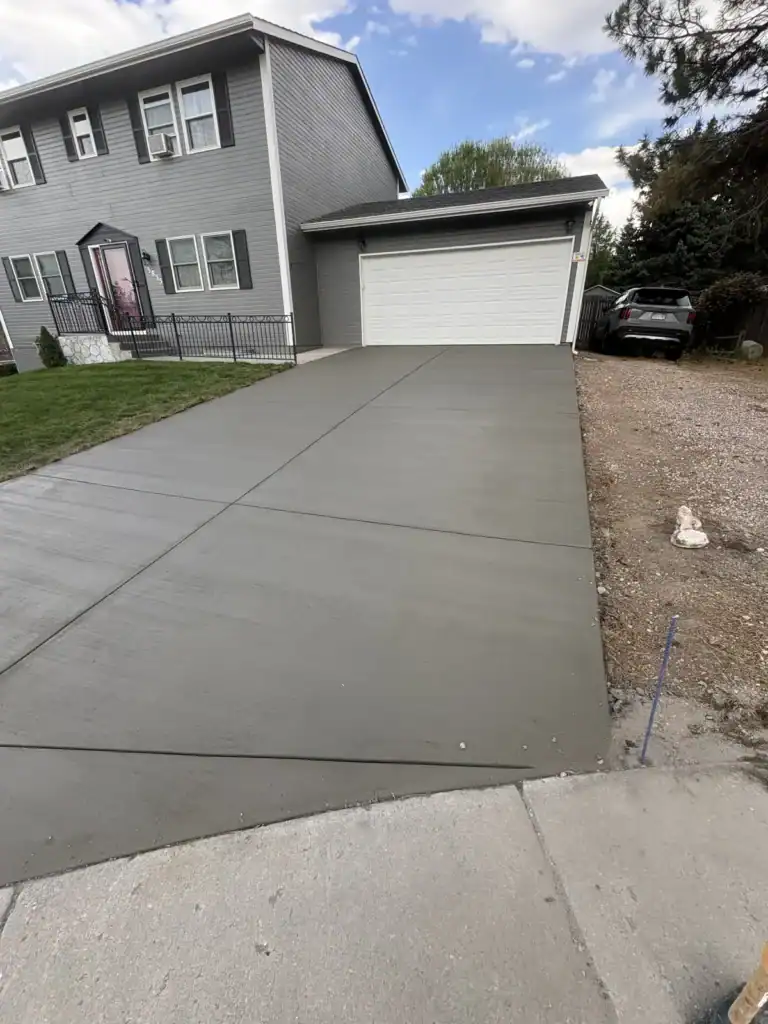
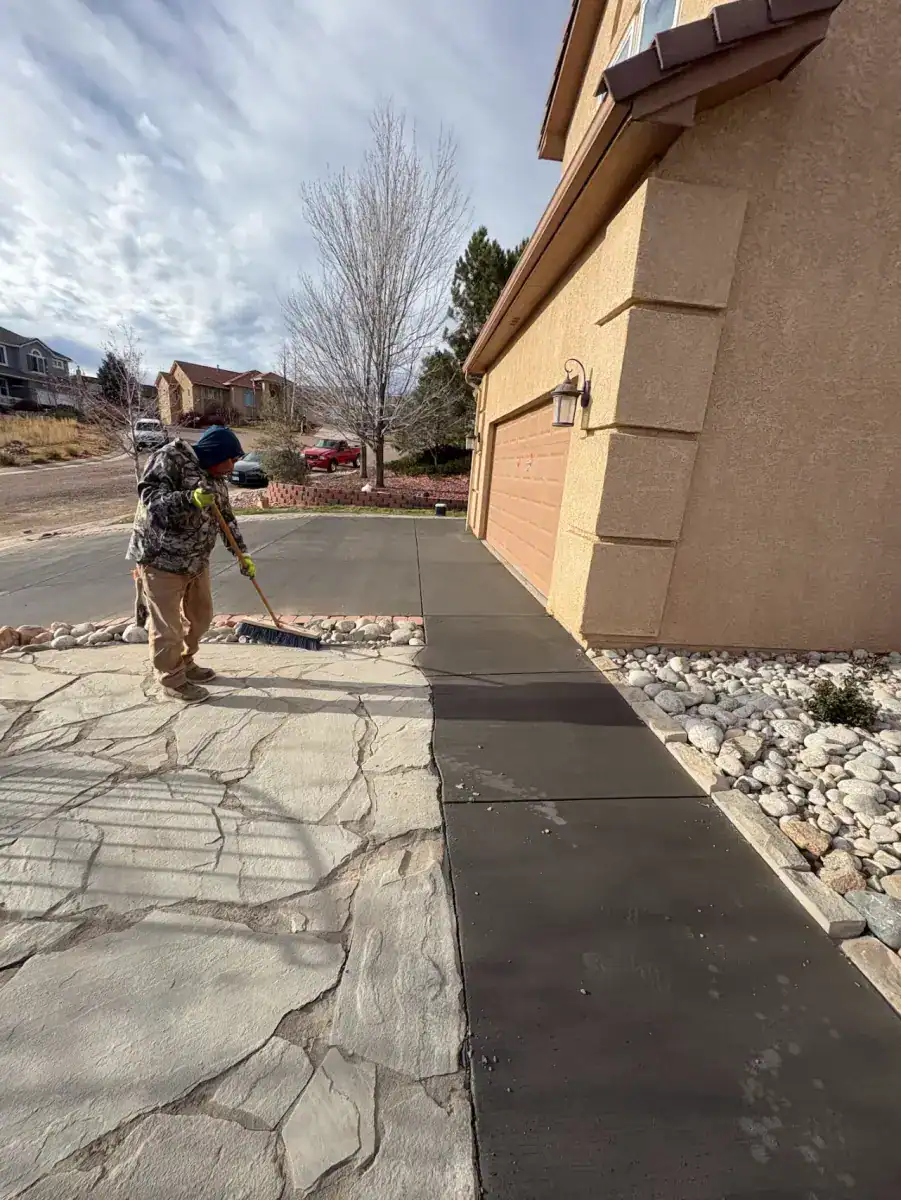
For a standard broom finish, the most common and practical choice for Colorado driveways, the crew drags a stiff-bristled broom across the surface in straight, parallel lines. This creates the familiar textured surface that provides excellent traction in rain, snow, and ice.
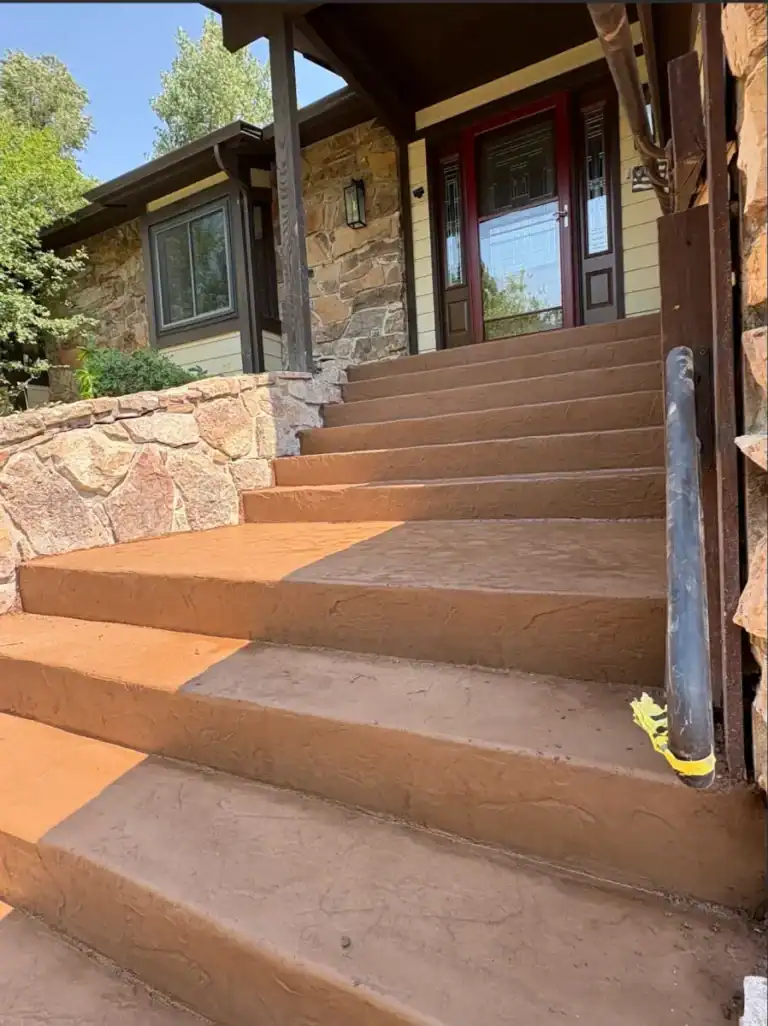
For decorative finishes (stamped, exposed aggregate, or colored concrete), the finishing phase is more involved and requires specialized tools and techniques. Stamped concrete requires applying color hardener and release agent, then pressing pattern mats into the surface before it sets, a labor-intensive process that demands precise timing.
Edging is done along all form edges to create a rounded profile that resists chipping. This is also when the crew hand-tools any transitions, such as where the driveway meets a sidewalk or garage apron.
Control Joints
Control joints are the planned lines where concrete is designed to crack, because all concrete cracks eventually, and joints give you control over where. The crew cuts or tools control joints into the surface at intervals no greater than 8-10 feet for a 4″ slab. Joints should be cut to a depth of at least one-quarter of the slab thickness.
Timing of control joint cuts is critical. Cut too early and the saw tears the fresh concrete. Cut too late and random cracks may have already formed. Joints are cut the same day, within hours of the pour, or tooled by hand into the wet concrete during finishing. The crew shouldn’t leave the site with the joints uncut.
The forms come off the following day and the edges are backfilled.
Always confirm your contractor is using at least a 4,000 PSI air-entrained concrete mix. This is non-negotiable for Colorado driveways. The 3,000 PSI mixes acceptable in milder climates don’t hold up to our freeze-thaw cycles, well over 100 of them a year. Air entrainment (5-7% air content) creates microscopic bubbles that give expanding ice room to grow without cracking the concrete from within.
After the Pour: Curing and First Use
The concrete is down and finished, but the project isn’t over. The curing period is when concrete develops its strength, and how you handle it determines the slab’s long-term performance.
First 24 Hours: Hands Off
The concrete is setting but still very fragile. No foot traffic, no pets, no touching the surface. Don’t wash it or apply water unless your contractor specifically instructs you to wet-cure.
24-48 Hours: Light Foot Traffic
You can walk on the surface carefully. The concrete has reached roughly 20-30% of its design strength. Keep heavy objects, wheelbarrows, and anything with wheels off the surface.
7 Days: Vehicle Traffic
The concrete has reached approximately 70-75% of its design strength, enough for passenger vehicles. Colorado’s dry curing conditions mean you should wait the full 7 days, not cheat by a day or two. If overnight temperatures dropped below 40°F during the first week, extend this to 10-14 days.
14 Days: Full Residential Use
At two weeks, the concrete is strong enough for all normal residential use including SUVs, trucks, and regular daily traffic. This is our recommended minimum before full use in Colorado’s climate.
28 Days: Full Design Strength
The industry standard for measuring compressive strength. Your 4,000 PSI mix should reach its rated strength by now. Heavy vehicles (RVs, moving trucks, dumpsters) should wait until this point.
We know it’s hard to park on the street for two weeks, but patience during curing prevents problems that last the life of the slab. Driving on concrete too early can cause surface damage, edge cracking, and internal stress fractures that don’t show up until the first winter. The few extra days are worth decades of performance.
What’s Under the Slab Matters More Than What’s On Top
If there’s one thing that separates a 30-year driveway from a 5-year driveway in Colorado Springs, it’s what’s underneath the concrete.
That doesn’t mean a thick gravel layer. A concrete slab spreads a wheel load over a wide footprint, so the pressure that actually reaches the ground is tiny, and almost any prepared soil carries it. What cracks slabs is non-uniform support: a soft spot next to a firm one, a pocket of loose fill, a void where water washed out the edge. Most Colorado Springs lots have sandy, well-draining native ground that, once graded and compacted, is exactly the uniform support a slab wants. Building codes recognize this; a base course isn’t required on well-drained sand and gravel soils.
So on a normal job, good site prep looks like this:
- Grade and compact the native ground — Cut to slab depth, establish the drainage slope, and compact so the support is uniform from one end to the other.
- Fix the exceptions — Loose fill, buried debris, or a soft spot gets dug out and replaced with compacted material. Gravel is used to regrade where the tear-out left the ground low or uneven.
- Drain it — Water running under the edge of a slab is what undermines it. The finished grade has to move water off and away, not under.
Be wary of a contractor who sells the same base package to every customer without looking at the ground, and equally wary of one who pours over whatever is there. The right answer comes from your lot.
How Long Does a Concrete Driveway Installation Take?
From start to driving on it, here’s a realistic timeline for a remove-and-replace driveway installation in Colorado Springs:
| Phase | Duration | Notes |
|---|---|---|
| Day 1: Demolition, grading, forms, rebar | 1 day | Sloped lots, complex shapes, or a lot of regrading can add time |
| Day 2: Pour, finish, control joints | 1 day | Morning pour on hot days; stamped/decorative finishes take longer |
| Form removal & cleanup | Next day | Forms pulled, backfill along edges |
| Curing (before driving) | 7-14 days | 14 days recommended in Colorado |
| Total (crew on site) | 2 days | Weather delays can extend timeline |
For new construction driveways (no demolition), day one is shorter. For larger driveways (800+ sq ft) or complex decorative work, add a day. Weather delays are common in Colorado. A responsible contractor will push the schedule rather than pour in bad conditions.
What Does a Concrete Driveway Installation Cost?
For a standard two-car driveway (400-600 sq ft) in Colorado Springs, expect to pay $8,000 to $12,000 for a plain broom finish, about $20 per square foot. Large driveways get a lower rate, $12-15 per square foot, and stamped or decorative finishes cost considerably more. Remove-and-replace projects add roughly $2 per square foot for demolition and hauling.
For a full cost breakdown by finish type, size, and all the factors that affect pricing, see our complete guide to concrete driveway costs in Colorado Springs.
Common Mistakes That Ruin Concrete Driveways
Knowing what can go wrong helps you spot problems before they become permanent. Here are the most common installation mistakes we see on failed driveways in the Colorado Springs area:
- Pouring on unprepared ground: Loose fill, organic soil, or no grading and compaction. The #1 cause of settling and cracking in Colorado
- Wrong concrete mix: Using 3,000 PSI or non-air-entrained concrete that can’t survive our freeze-thaw cycles
- Wrong reinforcement: Wire mesh or loose fibers in the mix passed off as reinforcement. Ask exactly what’s included in your quote, and confirm it’s bars in a tied grid
- Adding water on site: Asking the driver to add water makes concrete easier to work but dramatically weakens the finished product
- Missing or poorly spaced control joints: Joints too far apart, not cut deep enough, or cut the next day after random cracks have already formed
- Pouring too thin: 3.5″ actual thickness (using unshimmed 2×4 forms for a “4-inch” slab) when a true 4″ is the standard
- Pouring in the heat of the day: Placing concrete on a hot, windy afternoon and letting the surface dry out before it’s finished. Causes plastic shrinkage cracks, dusting, and a weak surface
- Pouring in bad weather: Rushing a pour when temperatures will drop below freezing overnight or rain is imminent
What to Do After Your Driveway Is Installed
Once your new driveway has cured, a little ongoing care keeps it performing for decades. Here’s what matters most in Colorado:
- Don’t buy a sealer for plain grey concrete — Air entrainment in the mix is the real freeze-thaw defense on a grey broom-finish slab, and we tell our customers not to buy a sealer program for it. Stamped, colored, and exposed-aggregate finishes are different: they’re sealed a few weeks after the pour and resealed every 2-3 years to protect the color and surface.
- No deicers the first winter, sand only — After the first year, use deicers sparingly if at all (mag chloride is the harshest on concrete surfaces), and never on colored or stamped finishes.
- Clean oil and fluid spills quickly — Concrete is porous. Automotive fluids left on the surface stain permanently if not cleaned within 24-48 hours.
- Keep control joints clear — Fill joints with a flexible backer rod and polyurethane sealant to prevent water infiltration and weed growth.
For our complete maintenance guide, see Concrete Driveway Maintenance Tips for Colorado Homeowners.
Frequently Asked Questions
How long does it take to install a concrete driveway?
Two days of crew work for a typical remove-and-replace driveway: day one for demolition, grading, forms, and rebar, day two for the pour and finish. It can be done in one day, but we usually don’t, because it pushes the pour into the afternoon, which matters on hot days. After the pour, you’ll wait 7-14 days before driving on it. The full project from demolition to first use is typically about two weeks.
Can I pour a concrete driveway myself?
Technically yes, but we strongly advise against it for anything larger than a small walkway. A driveway pour involves coordinating a concrete truck delivery with a tight finishing window. Once concrete arrives, the clock is ticking and there’s no pause button. Professional crews work in coordinated sequence to screed, float, finish, and joint the surface before it sets. A DIY mistake on a driveway means thousands of dollars of concrete that has to be demolished and done over.
What thickness should a concrete driveway be in Colorado?
A true 4″ is the residential standard for cars, SUVs, and light pickups, and it’s what most Colorado Springs driveways should be. The apron where the driveway meets the street should be 6″ (the City of Colorado Springs requires it), because that’s where garbage and delivery trucks put their wheels. For driveways that will carry an RV, a trailer, or a heavy work truck, 5-6″ throughout is the right call.
Do I need a permit for a driveway in Colorado Springs?
Usually yes, especially if you’re modifying the approach where your driveway meets the street, changing the driveway’s footprint, or working near the public right-of-way. Simple like-for-like replacements within the existing footprint may not require a permit, but check with your contractor. Permit fees typically run $75-$250 for residential driveway work.
What’s the best concrete mix for a Colorado driveway?
A 4,000 PSI air-entrained mix with 5-7% air content. The higher PSI provides the compressive strength needed for vehicle loads, and air entrainment is critical for surviving Colorado’s freeze-thaw cycles, well over 100 a year. Never accept a 3,000 PSI mix for a driveway in Colorado.
How much does it cost to replace a concrete driveway?
In Colorado Springs, a full remove-and-replace driveway runs about $20 per square foot for plain concrete on a typical two-car driveway ($12-15 on large projects), plus roughly $2 per square foot for demolition. A standard two-car driveway (400-600 sq ft) with broom finish typically costs $9,000-$13,000 including removal. Stamped or decorative finishes run considerably more and are quoted per project. See our full driveway cost guide for detailed breakdowns.
How do I know if my contractor is doing a quality installation?
Watch for these signs of quality work: the ground graded and compacted before forms go up (not just poured over whatever was there), reinforcement bars in a tied grid (not wire mesh), forms set with a laser level or string line, concrete placed and screeded without adding extra water, and control joints cut before the crew leaves. For more contractor selection tips, read our guide on how to choose a concrete contractor in Colorado Springs.
- The process takes two days of crew work (form one day, pour the next) plus 7-14 days of curing
- On hot days (90°F+), the pour should happen in the morning, not the afternoon
- Most Colorado Springs lots don’t need a gravel base; graded, compacted native ground is the goal
- Colorado requires 4,000 PSI air-entrained concrete (5-7% air content)
- Confirm your quote includes reinforcement bars in a tied grid, not wire mesh or loose fibers
- Control joints should be cut every 8-10 feet, at least 1/4 of slab depth, the same day as the pour
- Wait 7-14 days before driving on new concrete (14 days recommended in Colorado)
- No deicers the first winter, sand only; after that, use them sparingly if at all
- Skip the sealer on plain grey; reseal stamped or colored finishes every 2-3 years
Ready for a New Concrete Driveway?
Get Your Free EstimateReady for a New Concrete Driveway?
Get Your Free EstimateRelated: Concrete Driveway Services | Concrete Driveway Cost Guide | Best Time to Pour Concrete in Colorado | Driveway Maintenance Tips