Concrete patio or wood deck? It’s one of the biggest outdoor living decisions Colorado homeowners face — and the answer isn’t as straightforward as the internet makes it seem. Both options create usable backyard space, but they perform very differently in our high-altitude climate, they cost very different amounts to build and maintain, and one of them comes with a fire safety advantage that matters more every year along the Front Range. This guide breaks down the real differences in cost, durability, maintenance, and long-term value so you can make the right choice for your Colorado home.
A concrete patio costs 30-60% less than a comparable wood or composite deck, lasts just as long (25-30 years), and requires a fraction of the maintenance. In Colorado’s high-altitude climate — with intense UV, extreme dryness, and growing wildfire risk — concrete’s advantages are even more pronounced. Wood decks make sense in specific situations (elevated entries, steep slopes, second-story access), but for ground-level outdoor living space, concrete is the better investment for most Front Range homeowners.
Upfront Cost: Concrete Patio vs Wood Deck
Let’s start with what most homeowners want to know first. The cost gap between a patio and a deck is wider than most people expect.
Concrete Patio Cost
A quality concrete patio in Colorado Springs costs $10 to $20 per square foot installed, depending on the finish. Broom finish is the most affordable; stamped and exposed aggregate are at the higher end. For a typical 400 square foot patio, that’s $4,000 to $8,000.
Wood Deck Cost
A wood deck runs significantly more because you’re building an elevated structure with footings, a subframe, railings, and stairs — not just a surface. Here’s what each material costs installed in 2026:
- Pressure-treated pine: $16 to $28 per square foot — the budget option, but the shortest lifespan in Colorado’s climate
- Cedar: $22 to $33 per square foot — naturally rot-resistant, but still vulnerable to UV and splitting at altitude
- Composite (Trex, TimberTech): $25 to $50 per square foot — low maintenance, but the highest upfront cost
For that same 400 square foot space, a deck costs $6,400 to $20,000 depending on the material — and that’s before railings, stairs, and permits push the number higher.
The Real Gap
Comparing the most common scenario — a standard broom-finish concrete patio ($10-14/sq ft) against a pressure-treated wood deck ($16-28/sq ft) — the deck costs 60-100% more for the same usable area. Choose cedar or composite and the gap widens to 2-3x the cost of concrete. Even a stamped concrete patio with color ($14-20/sq ft) comes in below most wood deck options.
Deck quotes often exclude railings ($20-35/linear foot), stairs ($75-150 per step), permits ($200-500 in Colorado Springs), and demolition of an existing structure. These extras can add $2,000 to $5,000+ to a deck project. Concrete patio quotes typically include everything — excavation, base prep, reinforcement, finishing, and sealer.
Lifespan: How Long Each Option Lasts in Colorado
National lifespan estimates don’t account for Colorado’s unique combination of intense UV, extreme dryness, and dramatic temperature swings. Both materials last shorter here than the numbers you’ll see on generic websites.
- Concrete patio: 25-30 years when properly installed with Colorado-appropriate base preparation, 4,000+ PSI air-entrained concrete, rebar reinforcement, and sealer. Some well-maintained concrete patios last 40+ years.
- Pressure-treated wood deck: 10-15 years in Colorado. National guides say 15-20, but our UV intensity and dry air accelerate cracking, splitting, and structural deterioration. Many Front Range decks show serious wear by year 8-10.
- Cedar deck: 15-20 years with diligent maintenance. Cedar’s natural oils resist rot, but Colorado’s UV breaks down those oils faster than in humid climates.
- Composite deck: 25-30 years. This is composite’s strongest selling point — it holds up to UV and moisture better than wood. But the upfront cost is 2-3x that of concrete.
UV radiation increases roughly 6-10% per 1,000 feet of elevation. At Colorado Springs’ altitude (6,035 feet), UV is up to 36% more intense than at sea level. This accelerated UV exposure breaks down wood fibers, dries out natural oils, and causes the graying, splitting, and splintering that Colorado deck owners know all too well. The same UV that gives us 300 days of sunshine shortens a wood deck’s life by 5-10 years compared to sea-level performance.
Maintenance: Where the Real Cost Difference Lives
Upfront cost gets all the attention. But for outdoor structures in Colorado, maintenance cost is where the financial picture really separates.
Concrete Patio Maintenance
- Sealing: Every 2-3 years ($1.50-3/sq ft professionally applied, or $0.25-0.75/sq ft DIY). Protects against moisture, freeze-thaw, UV, and staining.
- Crack monitoring: Fill any cracks that develop before winter. With proper installation, this is minimal.
- Cleaning: Pressure wash once a year or as needed. That’s it.
Wood Deck Maintenance
- Staining/sealing: Every 1-2 years in Colorado ($2-4/sq ft professionally, $550-1,400 per cycle for a typical deck). National guides say every 2-3 years, but Colorado’s UV demands a shorter cycle — skip a year and the wood starts splitting.
- Board replacement: Plan on replacing warped, split, or rotting boards starting around year 5-7. Individual boards run $5-15 each plus labor.
- Structural inspection: Check joists, posts, and ledger connections annually. Dry rot in Colorado’s arid climate can compromise structural members without visible surface damage.
- Fastener maintenance: Screws and nails work loose as wood expands and contracts through temperature cycles. Popped fasteners are a safety hazard and need regular attention.
15-Year Maintenance Cost Comparison
For a 400 square foot outdoor space over 15 years:
Concrete patio:
- Sealing (5-6 applications): $1,200-$2,400
- Occasional crack repair: $100-$300
- Total maintenance: $1,300-$2,700
Pressure-treated wood deck:
- Staining/sealing (8-10 applications): $4,400-$11,200
- Board replacement: $500-$1,500
- Fastener and hardware maintenance: $200-$500
- Total maintenance: $5,100-$13,200
- Plus full replacement at year 12-15: $6,400-$11,200
That’s a $4,000 to $10,000+ difference in maintenance alone — and the wood deck may need full replacement within that timeframe while the concrete patio is barely halfway through its life.
The 20-Year Cost Comparison
Here’s what each option actually costs over 20 years when you include installation, maintenance, and replacement:
| Cost Category | Concrete Patio | Wood Deck (PT) | Composite Deck |
|---|---|---|---|
| Initial Install (400 sq ft) | $4,000-$8,000 | $6,400-$11,200 | $10,000-$20,000 |
| Maintenance (20 yrs) | $1,800-$3,600 | $7,000-$17,600 | $500-$1,500 |
| Replacement | Not needed | $8,000-$14,000 at ~yr 13 | Not needed |
| 20-Year Total | $5,800-$11,600 | $21,400-$42,800 | $10,500-$21,500 |
| Lifespan | 25-30 years | 10-15 years (CO) | 25-30 years |
A concrete patio costs roughly half of what a composite deck costs over 20 years — and one-third of a wood deck’s total cost when you factor in the replacement cycle that Colorado’s climate demands.
How Colorado’s Climate Affects Each Material
This is where the comparison gets Colorado-specific. National guides treat patios and decks as roughly equivalent in durability. In our climate, they’re not.
UV Damage at Altitude
At 6,000+ feet, Colorado’s UV intensity is up to 36% higher than at sea level. This is devastating for wood:
- Wood fibers break down and turn gray within months of exposure
- Natural oils dry out faster, leading to cracking and splintering
- Stain and sealant break down faster, requiring more frequent reapplication
- Even pressure-treated lumber loses its protective chemicals faster under intense UV
Concrete doesn’t have organic fibers to break down. UV causes minor surface lightening over decades, but it doesn’t compromise the material’s structural integrity or appearance in any meaningful way. A sealed concrete patio looks essentially the same after 10 years of Colorado sun as it did when it was poured.
Extreme Dryness
Colorado’s average humidity is among the lowest in the country. Wood needs some moisture to stay flexible and structurally sound. In our climate:
- Deck boards dry out, shrink, and develop gaps between them
- End grain splits and checks (deep cracks along the wood grain) appear within 2-3 years
- Fasteners loosen as the wood around them shrinks
- Structural members like joists and posts can develop hidden dry rot that’s not visible from the surface
Concrete actually performs better in dry climates. Once cured, concrete doesn’t need ambient moisture. Our dry air means fewer issues with surface efflorescence (white mineral deposits) compared to humid regions.
Freeze-Thaw Cycles
Colorado Springs sees 100+ freeze-thaw cycles per year. Water that seeps into wood grain freezes, expands, and splits the fibers from the inside — the same process that destroys poorly installed concrete, but wood is far more porous and absorptive.
Properly installed concrete handles freeze-thaw well. Air-entrained concrete (the standard in Colorado) contains tiny air bubbles that give expanding ice room to grow without cracking the slab. Wood has no such built-in defense.
- UV at altitude (36% more intense) grays and degrades wood far faster than national estimates suggest
- Extreme dryness causes wood shrinkage, splitting, and hidden structural deterioration
- 100+ freeze-thaw cycles per year damage wood from the inside out
- Concrete handles all three challenges better when properly installed for Colorado conditions
- Wood deck lifespans in Colorado are 5-10 years shorter than national averages
Fire Safety: A Growing Colorado Concern
This is the factor that most patio-vs-deck comparisons ignore — and it’s increasingly important along the Front Range.
Colorado’s wildfire risk is growing. The Marshall Fire (2021) destroyed over 1,000 homes in the Boulder area. The Waldo Canyon Fire (2012) and Black Forest Fire (2013) hit close to Colorado Springs. Many Front Range neighborhoods sit in or near the Wildland-Urban Interface (WUI), where wildfire codes are becoming stricter every year.
The 2025 Colorado Wildfire Resiliency Code
Colorado adopted the Colorado Wildfire Resiliency Code (CWRC) effective June 2025. In designated WUI areas, new construction and major remodels must meet fire-resistant material standards. For decks, this means:
- Deck surfaces must meet Class A flame spread ratings in many WUI zones
- Standard pressure-treated and cedar lumber do not meet Class A requirements
- Composite decking varies — some products meet Class A, others don’t
- Noncombustible materials are required within 5 feet of the structure in many jurisdictions
Concrete is inherently noncombustible. It doesn’t burn, doesn’t spread flame, and meets the strictest fire codes without special products or treatments. A concrete patio actually serves as defensible space around your home — it’s a fire break, not a fire risk.
Many Colorado Springs neighborhoods — especially those near the foothills, Black Forest, and Monument areas — are in or adjacent to WUI zones. Before investing in a wood deck, check with the Pikes Peak Regional Building Department to see if fire-resistant materials are required. A standard wood deck may not be allowed — or may need expensive fire-rated materials that push the cost even higher.
Design and Aesthetics
This is the one area where decks have a legitimate advantage — but it’s narrower than you might think.
Where Decks Win
- Elevated outdoor space: If your back door is well above grade, a deck creates a level transition that a ground-level patio can’t. This is common with walkout basements and sloped lots.
- Railing and enclosure: Built-in railings create a defined outdoor “room” feel that some homeowners prefer.
- Under-deck storage: The elevated structure creates covered space underneath for storage or a lower-level patio.
- Natural wood warmth: Wood has a warm, organic look that appeals to many homeowners — though it fades to gray within a year or two in Colorado without constant maintenance.
Where Concrete Wins
- Design versatility: Stamped patterns (stone, brick, slate, wood plank), integral colors, exposed aggregate, decorative borders, and saw-cut designs. Concrete offers more visual options than wood.
- Seamless surface: No gaps between boards, no splinters, no raised fasteners. A smooth, continuous surface that’s ideal for furniture, bare feet, and kids playing.
- Ground-level flow: A patio creates a natural extension of your yard. Step off the patio and you’re on the grass — no stairs, no railing barrier.
- Furniture-friendly: Heavy furniture, grills, fire pits, and hot tubs sit stable on concrete. Deck boards can dent, stain, and sag under heavy loads.
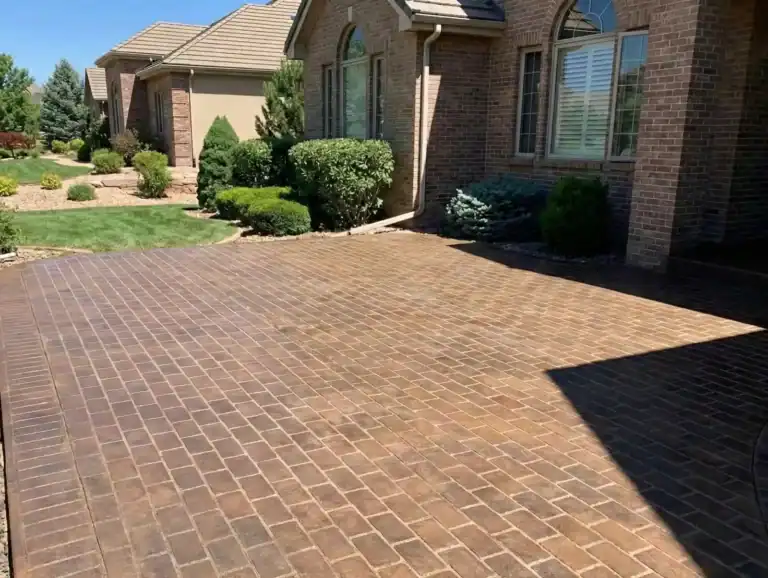
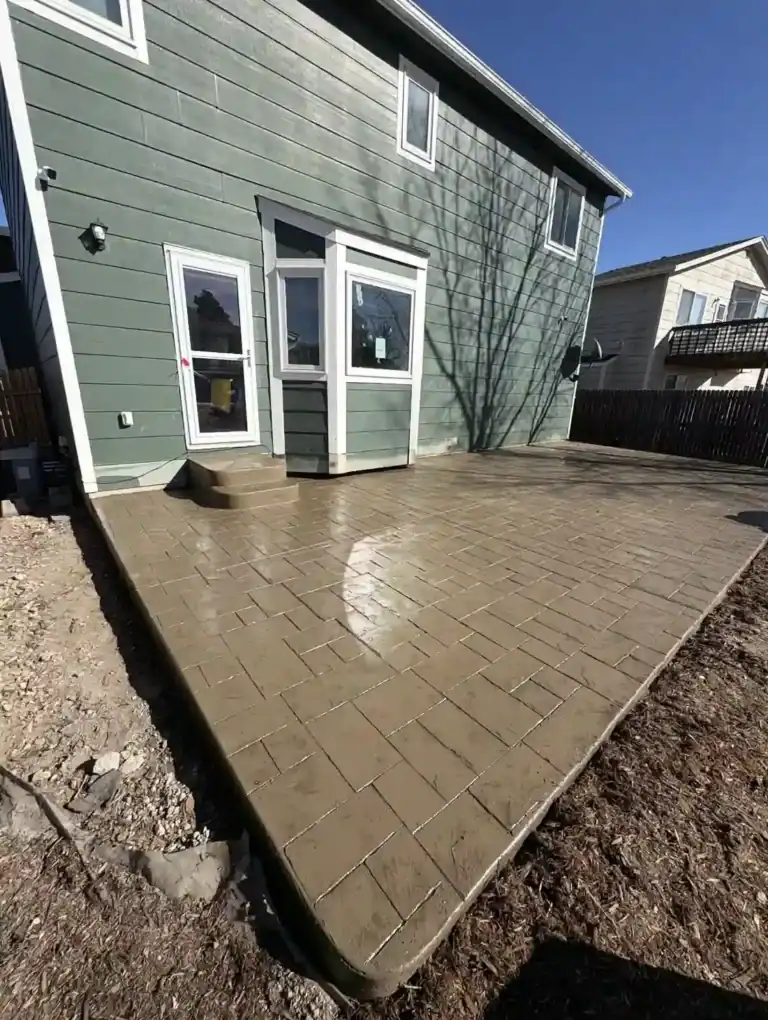
Here’s something most homeowners don’t realize until they see it: a stamped concrete patio in an ashlar slate pattern with warm-toned integral color often looks more like natural stone than a wood deck looks like… well, anything other than a deck. Concrete’s design options have expanded dramatically in recent years.
Resale Value
Both patios and decks add value to a home. But the return on investment looks different for each:
- Wood decks: Industry estimates suggest a 50-75% return on investment — but that assumes the deck is in good condition at the time of sale. A weathered, graying deck with split boards is a liability, not a selling point. In Colorado, a 10-year-old wood deck often looks like it needs replacement.
- Concrete patios: Typically yield a 50-80% return on investment. The advantage: a 10-year-old concrete patio still has 15-20 years of life left and still looks good. Buyers see it as a feature, not a future expense.
- Composite decks: Best resale value among deck options because buyers know they won’t need to replace or maintain it. But the higher upfront cost means the percentage return is similar to concrete.
Real estate agents along the Front Range report that buyers pay close attention to outdoor living space — but they also scrutinize maintenance issues. A well-maintained concrete patio is a selling point. A weathered wood deck raises questions about how much it’ll cost to fix or replace. In a competitive market, the outdoor space that looks move-in ready wins.
When a Wood Deck Makes Sense
We install concrete patios, so we’re biased. But a deck is genuinely the better choice in certain situations:
Your Back Door Is Elevated
If your main floor is 3+ feet above the backyard grade — common with walkout basements and hillside lots — a deck provides a level transition from your door to the outdoors. Building a ground-level patio in this scenario would require extensive grading, retaining walls, or stairs that may cost more than a simple deck.
You Have a Steep Slope
On a steeply sloped lot, a deck can cantilever over the grade change, creating usable space where a patio would require massive amounts of fill or retaining work. This is common in Skyway, Cheyenne Canyon, and foothills neighborhoods.
You Want Second-Story Access
A second-story deck off an upper-level living space is something concrete can’t do. If your primary entertaining space connects to an upper floor, a deck is the practical choice.
You're Choosing Composite
If budget isn’t the primary concern and you want a low-maintenance elevated outdoor space, a composite deck offers durability competitive with concrete. The 25-30 year lifespan and minimal maintenance close the gap — though the upfront cost is still 2-3x higher.
When a Concrete Patio Is the Better Investment
Your Yard Is Relatively Flat
If your backyard is at or near the same level as your back door, there’s no structural reason to build an elevated deck. A ground-level concrete patio gives you the same usable space at 30-60% less cost — without the maintenance burden.
You Want Low Maintenance
Sealing a concrete patio every 2-3 years is the only significant upkeep task. Compare that to wood’s annual staining, board replacement, fastener tightening, and structural checks. If you’d rather spend weekends using your outdoor space instead of maintaining it, concrete wins.
You're in or Near a Fire Zone
If your property is in a WUI zone or anywhere near the foothills, concrete’s noncombustible nature isn’t just a nice-to-have — it may be a code requirement. Even outside designated fire zones, a concrete patio contributes to defensible space around your home.
Budget Matters
For ground-level outdoor space, concrete delivers the most usable square footage per dollar. A $7,000 budget gets you a 400+ sq ft stamped and colored concrete patio — or a 250-300 sq ft pressure-treated deck that’ll need replacing in 12 years.
You Plan to Stay Long-Term
Concrete’s 25-30 year lifespan means one installation covers your entire time in the home. A wood deck will need at least one full replacement in that span — an expense of $6,000 to $14,000+ that erases the feeling of having “saved” on the initial build.
What About Composite Decking as a Third Option?
Composite decking (Trex, TimberTech, Fiberon) deserves a mention because it solves many of wood’s problems — UV resistance, no staining required, no splitting or splintering. In Colorado’s climate, composite is clearly superior to wood for decking.
But composite doesn’t change the fundamental patio-vs-deck equation:
- It still requires an elevated substructure (footings, joists, beams) — which is where much of a deck’s cost comes from
- Installed costs of $25-50/sq ft make it 2-3x more expensive than concrete
- It still needs railings, stairs, and permits
- The substructure is still wood or steel, which can deteriorate even if the deck surface doesn’t
Composite is the right choice if you need a deck (elevated access, steep slope, second story) and want to minimize long-term maintenance. But if you’re building at ground level and comparing composite to concrete purely for outdoor living space, concrete gives you more square footage and more design options for less money.
The Bottom Line for Colorado Homeowners
For ground-level outdoor living space — which is what most Colorado Springs homeowners are building — a concrete patio is the smarter investment by almost every measure. It costs 30-60% less upfront, lasts as long or longer, requires a fraction of the maintenance, handles Colorado’s brutal UV and temperature swings better, and doesn’t burn.
Wood decks have their place: elevated access, steep lots, and second-story living spaces. But if you’re choosing between a deck and a patio for a backyard entertaining area at or near ground level, the math overwhelmingly favors concrete — especially when you account for Colorado’s climate impact on wood over time.
- Concrete patios cost $10-20/sq ft installed; wood decks cost $16-50/sq ft depending on material
- Over 20 years, a concrete patio costs roughly half of a composite deck and one-third of a wood deck
- Wood deck lifespans in Colorado are 5-10 years shorter than national averages due to 36% more intense UV at altitude
- Concrete maintenance: seal every 2-3 years. Wood maintenance: stain/seal every 1-2 years + board replacement + structural inspection
- Concrete is noncombustible — it meets the strictest WUI fire codes and serves as defensible space
- Standard wood decking does not meet Class A fire ratings required in many Colorado WUI zones
- Concrete offers more design options than most homeowners realize — stamped, colored, aggregate, decorative borders
- Decks make sense for elevated entries, steep slopes, and second-story access
- For ground-level outdoor living in Colorado, concrete is the clear winner on cost, durability, maintenance, and fire safety
Get a Free Concrete Patio Estimate
Request Free QuoteRelated: Concrete Patio Services | Concrete Patio Cost Guide | Concrete Patio Ideas for Colorado