Asphalt resurfacing in Colorado Springs, when the base is still good.
A new layer of asphalt over a worn driveway, private road, or small lot — for less than tearing it all out. It’s a great fix for the right pavement and the wrong one for others, so we start by telling you which you have.
Rated 5.0 by Colorado homeowners
Had a great experience with Crestone! John was super responsive and fair in bidding the installation of a hot tub pad, sidewalk, and stoop for my house.
Work was great every thing was smooth from the estimate to the completion would highly recommend
Had a great experience with this team, really enjoyed working with John to really capture what I wanted done for my patio. Great team and even better people. Highly recommend them!!
A new surface on an old foundation
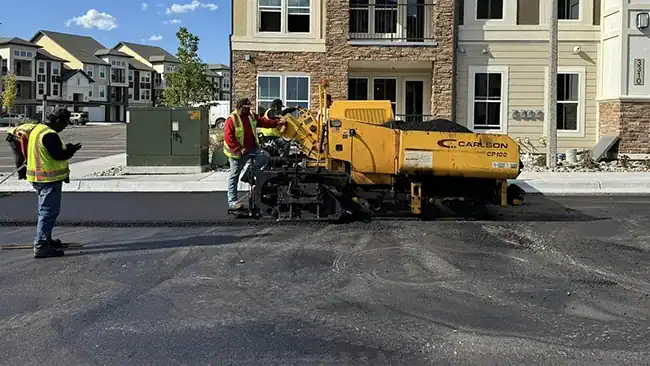
Resurfacing — also called an asphalt overlay — means paving a fresh layer of hot-mix asphalt, typically 1½″ to 2″ after compaction, over your existing pavement. You get a new, black, smooth surface without paying to remove and rebuild everything underneath. When the old asphalt is gray, rough, and worn on top but still firm below, it’s often the best value in paving.
The catch is in the name: an overlay sits on what’s already there. It takes on the shape and the strength of the old pavement, so it suits driveways that are tired, not ones that are broken. The honest part of our job is telling those two apart before you spend the money.
When an asphalt overlay makes sense — and when it doesn’t
Usually a good candidate
The surface is faded, rough, or shedding small stones. Cracks are mostly individual lines rather than a web. The pavement feels solid under a vehicle, water drains off it, and any bad areas are limited enough to cut out and patch first.
Usually not a candidate
Large areas of alligator cracking, soft or sunken spots, or ruts — signs the trouble is below the surface, where an overlay can’t reach. The same goes for a blacktop driveway that already ponds water or has been overlaid before. Those are generally better off replaced.
The height question
An overlay raises the surface. Where the driveway meets the garage floor, the street, or a walkway, the old asphalt has to be cut or ground down so the new layer ties in flush — otherwise you get a lip, or water running toward the garage.
How asphalt resurfacing gets done
The same clear steps on every job — you’ll know what’s happening and why.
Assess the existing pavement
We walk it with you, look at the cracking pattern, drainage, soft spots, and heights at the garage and street, and tell you plainly whether an overlay is a sound choice.
Written scope & price
Your estimate states the overlay thickness, which areas get repaired first, and how the transitions are handled.
Repair the bad areas first
Failed spots are cut out and patched, and wider cracks are filled, so the new layer isn’t laid over known problems.
Prepare transitions & clean
Old asphalt is cut or ground down where it meets the garage, street, and walks. The surface is cleaned and a tack coat is applied so the new layer bonds to the old.
Pave & compact the overlay
Hot-mix asphalt is placed and rolled while hot to the specified compacted thickness.
Walkthrough & care
We review the finished surface with you and leave care instructions for the first few weeks.
Every asphalt resurfacing project, standard
- ✓A straight answer firstWhether your pavement is a candidate, before any price.
- ✓Bad areas repaired before pavingCut out and patched so they aren’t buried.
- ✓Flush transitionsAt the garage, the street, and walkways.
- ✓Tack coat for bondSo the new layer adheres to the old surface.
- ✓Overlay thickness in writingTypically 1½″–2″ compacted.
- ✓Written estimate & clean-upScope spelled out up front; site left clean.
What asphalt resurfacing costs
Resurfacing generally costs meaningfully less than tearing out and replacing the same pavement, because there’s no removal and haul-off and less new asphalt. Our asphalt projects start at $4,500.
How much you save depends on how much repair the old surface needs first. If the prep work starts approaching the cost of replacement, we’ll tell you — at that point a new driveway is the better use of the money. Your written estimate is a fixed price with the thickness, repairs, and transition work listed.
- ▲AreaLarger surfaces get a lower rate per square foot.
- ▲Repairs needed firstEvery failed spot that has to be cut out and patched adds cost.
- ▲TransitionsCutting or grinding at the garage, street, and walks so the new layer sits flush.
- ▲Overlay thicknessA 2″ overlay uses about a third more asphalt than 1½″.
- ▲Drainage correctionsBuilding up low areas so water runs off the new surface.
- ▲Distance from the plantHot asphalt is trucked from Colorado Springs plants; farther properties cost more to reach.
Asphalt resurfacing FAQ
Can my asphalt driveway be resurfaced instead of replaced?
Will the old cracks come back through the new asphalt?
How thick is an asphalt overlay?
How long does resurfacing last?
Will resurfacing raise my driveway?
How much does it cost to resurface an asphalt driveway?
Is resurfacing the same as sealcoating?
Do you resurface blacktop driveways?
Driveway guides
Straight answers from our blog.
More asphalt services
Find out if yours can be resurfaced
Tell us about your project and we’ll walk the site and give you a fair, written price.