If you’re a Colorado Springs homeowner considering a new concrete driveway installation in Colorado Springs, your first question is probably: “How much is this going to cost?” The answer depends on the size of the driveway, the finish you choose, and whether an old slab has to come out first. In this guide, we’ll break down real 2025-2026 pricing for the Colorado Springs area so you can budget accurately for your project.
In Colorado Springs, a quality plain broom-finish concrete driveway runs $12 to $20 per square foot installed, depending on project size: about $20 on a typical two-car driveway of around 500 square feet, dropping to $12-15 on large projects. Smaller projects cost more per square foot, and colored, stamped, and other decorative finishes cost considerably more. For a standard two-car driveway (400-600 sq ft), expect roughly $8,000 to $12,000 in plain concrete. Tearing out an old driveway adds about $2 per square foot.
Why Colorado Concrete Costs More Than National Averages
Before we dive into specific prices, it’s important to understand why concrete work in Colorado Springs costs more than the national averages you might see online. Those “$5-7 per square foot” quotes you’ll find on generic websites don’t reflect what a properly built driveway costs here:
An exterior mix built for freeze-thaw: Colorado Springs sees well over 100 freeze-thaw cycles a year. Concrete that survives that needs to be air-entrained and poured at 4,000 PSI, not the cheapest mix the plant offers.
Extreme temperature swings: Colorado Springs can see 40-degree temperature swings in a single day, especially in spring and fall. Pours have to be timed, cured, and jointed carefully, which takes an experienced crew and more attention per job.
A short season and a tight labor market: Good finishing crews are booked from spring through fall. Skilled labor, pump trucks, and disposal fees all cost more along the Front Range than they do in many other regions.
Cutting corners on mix, reinforcement, and finishing is the fastest way to end up with cracks and costly repairs within a few years. The prices below reflect what quality installation actually costs in our market, not the bargain-basement quotes that lead to premature failure.
Average Concrete Driveway Costs in Colorado Springs (2025-2026)
Based on our own completed projects in the El Paso County area, here’s what Colorado Springs homeowners are paying for properly installed concrete driveways:
Cost by Finish Type
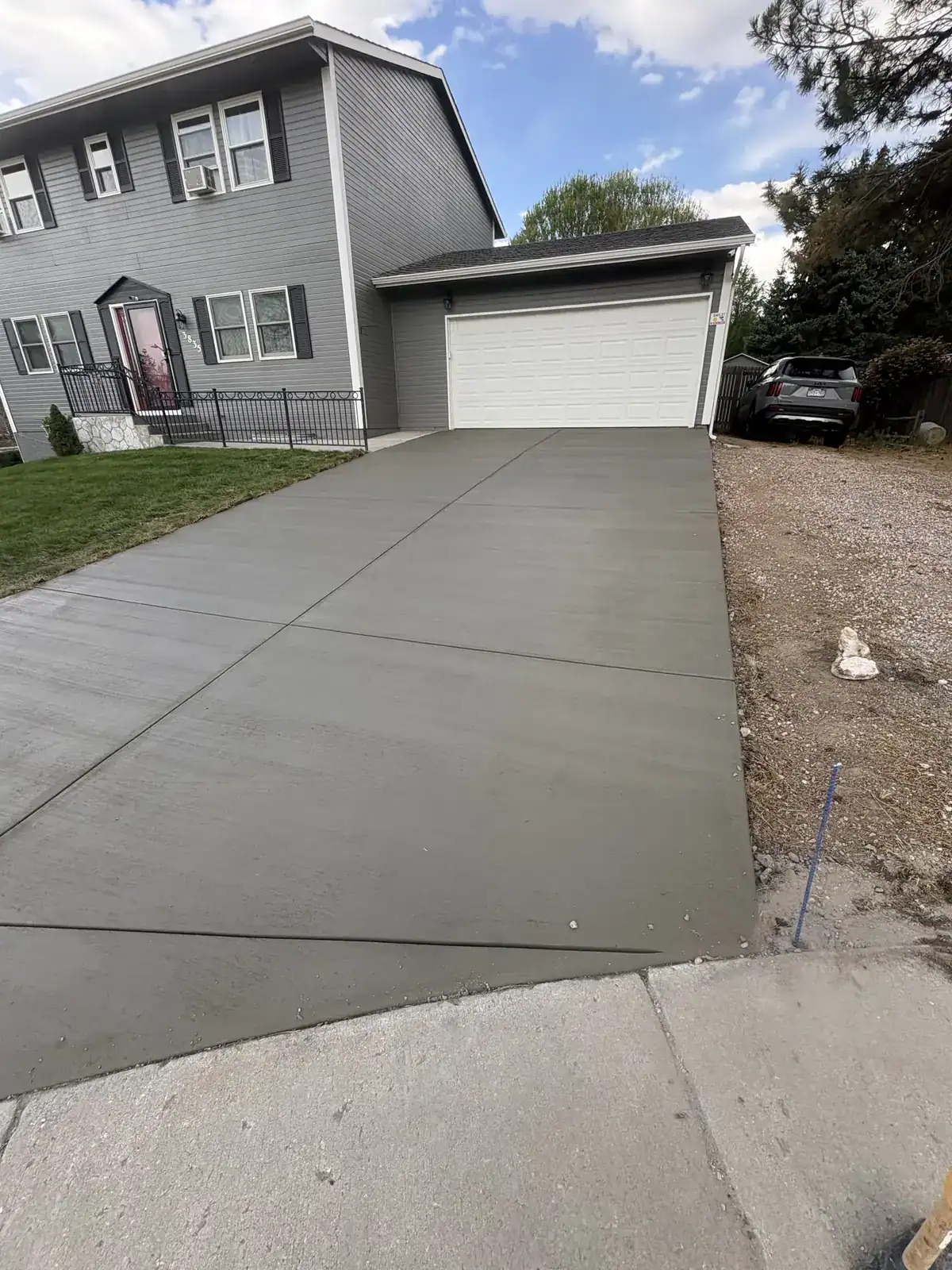
Plain/Broom Finish Concrete: A standard gray concrete driveway with a broom finish costs about $20 per square foot on a typical two-car driveway of around 500 square feet, and drops to $12 to $15 per square foot on large projects where the fixed costs spread over more concrete. That price includes grading, forming, 4,000 PSI air-entrained concrete, fiber rebar reinforcement, finishing, control joints, and cleanup. This classic finish provides excellent traction and durability, and it’s the best value for most homes.
Why smaller projects cost more per square foot: A lot of what goes into a driveway is fixed no matter the size: mobilization, the crew’s day, forming, the pump truck if one is needed. Spread those costs over 300 square feet instead of 500 and the per-square-foot number climbs. We price every project at a $6,500 minimum for the same reason. The same logic runs the other way: on a big pour those fixed costs are spread across a lot more concrete, which is why large driveways come down toward $12-15 per square foot.
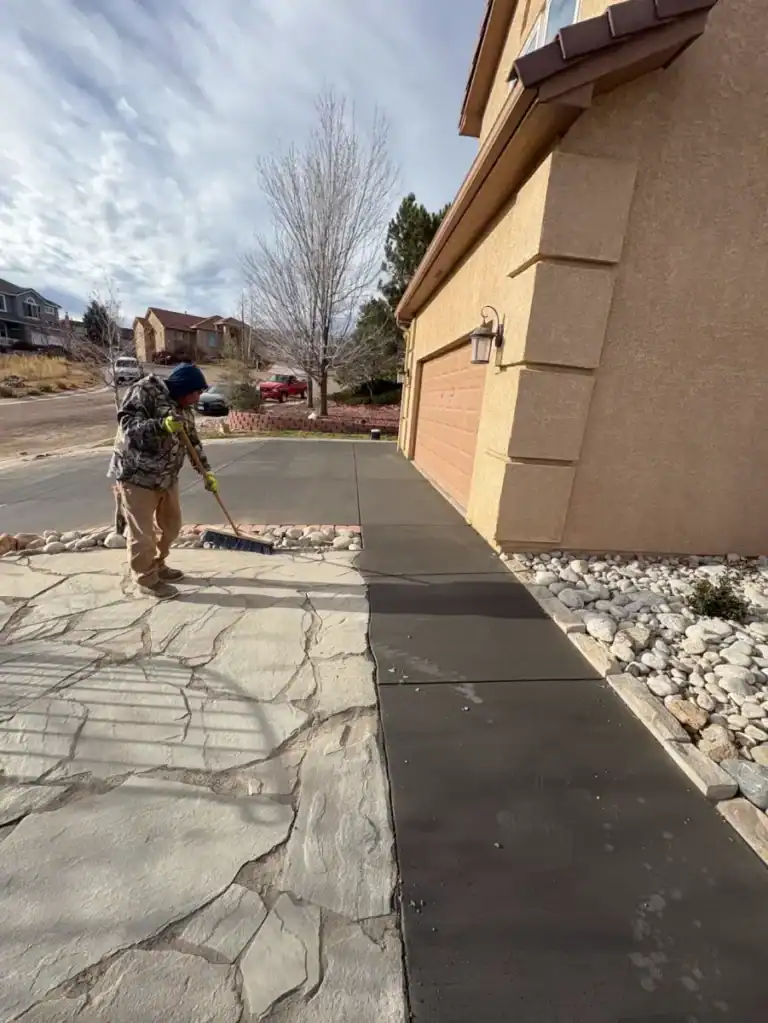
Colored Concrete: Integral color is mixed through the entire batch, so it won’t peel or wear off like a surface treatment. Pigment is priced by the yard of concrete and varies a lot by color: earth tones like buff and tan are the most affordable, while dark grays and blacks cost several times as much. Colored driveways are quoted per project and run noticeably above plain-concrete pricing.
Exposed Aggregate: This finish reveals the natural stone within the concrete for a textured, decorative look with excellent slip resistance. It adds a few dollars per square foot over a broom finish for the extra material and the washing and finishing labor.
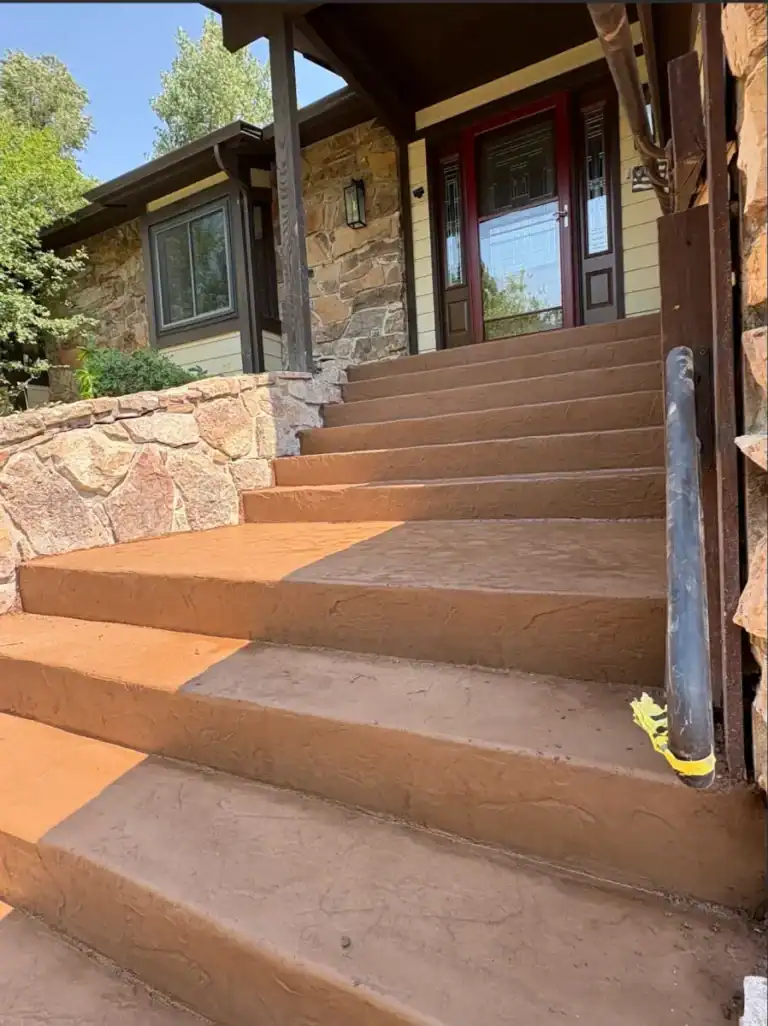
Stamped Concrete: The premium option. Stamped concrete mimics the look of brick, stone, or tile at a fraction of the cost of the real materials, but it’s the most labor-intensive finish there is: color, release agents, stamping, detailing, and sealing all add time and product. Stamped driveways commonly land at roughly 1.25 to 2 times the price of plain concrete, with a single pattern in one color at the low end and multi-color designs, borders, or custom work at the high end. Every stamped project is quoted individually.
Total Project Cost by Driveway Size
Driveway sizes vary significantly based on your garage configuration and property layout. Here’s what to expect based on common driveway dimensions, in plain broom-finish concrete:
Small or Single-Car Driveway (under 350 sq ft)
A typical single-car driveway measures 10-12 feet wide by 18-20 feet long. Projects this size fall under our $6,500 project minimum, and the per-square-foot price runs higher than the $20 figure above because the fixed costs of the job don’t shrink with the slab. Budget from $6,500 for a small driveway in plain concrete.
Two-Car Driveway (400-600 sq ft)
Standard two-car driveways are 20-24 feet wide by 18-24 feet long. This is the most common size we see in Colorado Springs neighborhoods. Total costs:
- Plain concrete: $8,000 – $12,000
- Stamped concrete: $10,000 – $24,000
Extended/Three-Car Driveway (600-900 sq ft)
Larger driveways for three-car garages or with extra parking space. At this size the per-square-foot rate starts coming down, roughly $15-18 for plain concrete:
- Plain concrete: $10,000 – $16,000
- Stamped concrete: $12,500 – $32,000
Large Driveways (1,000+ sq ft)
Long driveways, RV pads, and big parking areas get the best per-foot pricing, about $12 to $15 per square foot in plain concrete. A 1,200 sq ft driveway runs roughly $14,500 to $18,000.
Measure your driveway area (length × width) and multiply by about $20 per square foot for a typical two-car driveway, or $12-15 for a large one. Add roughly $2 per square foot if an old driveway has to come out. That gives you a realistic baseline before any decorative upgrades.
These ranges assume the driveway is actually built for Colorado conditions: air-entrained 4,000 PSI concrete, fiber rebar reinforcement, and grading that drains. You can see exactly what goes into ours on our concrete driveway services in Colorado Springs page.
Factors That Affect Your Final Price
The per-square-foot costs above assume relatively standard conditions. Several factors can push your final price higher:
1. Removal of Existing Driveway
If you’re replacing an old driveway, the tear-out has to be broken up, loaded, hauled, and disposed of at a licensed facility. On most of our projects, removal adds about $2 per square foot to the price, so roughly $1,000 on a 500 sq ft driveway. Thick slabs, heavy reinforcement, or tight access can push that higher, which is why it’s quoted per project. Not sure the old slab needs to go? Our guides on whether to repair or replace a concrete driveway and resurfacing vs. replacement walk through when each makes sense.
2. Grading and Site Preparation
This is one of the most misunderstood line items in concrete pricing, and it’s where a lot of online cost guides get Colorado Springs wrong. Most lots here sit on sandy, gravelly, well-draining native ground. Prepared and compacted, that ground is an excellent subgrade for a driveway, and building codes recognize it as such. On a normal job we don’t install a gravel base layer at all. When we do bring in gravel, it’s to regrade: to fill low spots, correct the slope, or re-establish the drainage line after a tear-out.
- Standard grading and compaction: Included in the base price
- Significant regrading or slope correction: $1,000 to $3,000, depending on how much material has to move
- Drainage solutions: $800 to $2,500 for French drains or channel drains
- Soft or unstable soil: Quoted per project if loose fill, organic soil, or a soft spot has to be dug out and replaced with compacted material
What matters is uniform support, not a thick layer of anything. A slab spreads wheel loads across a wide footprint, so almost any prepared soil carries it; what cracks slabs is a soft spot next to a firm one. Your contractor should look at your actual ground and grade to it, not sell you a one-size-fits-all base package.
3. Concrete Thickness
Four inches is the residential standard for cars and light SUVs, and it’s what most Colorado Springs driveways should be. Two situations call for more:
- 4 inches: Standard for residential driveways carrying cars, SUVs, and light pickups
- 6 inches at the apron: The City of Colorado Springs requires 6 inches where the driveway crosses the public right-of-way, because that’s where garbage and delivery trucks put their wheels
- 5-6 inches throughout: Worth the extra concrete if you park an RV, a trailer, or a heavy work truck on the driveway
Thicker concrete carries heavier vehicles; it doesn’t stop freeze-thaw damage. Air entrainment in the mix does that. Where thickness matters most is the street end: a 4-inch slab that’s fine at the garage will crack at the apron under a garbage truck, which is exactly why the city’s spec is 6 inches there. Also ask how thickness is measured. Industry core data shows a nominal 4-inch slab often averages about 3-5/8 inches as built, so make sure the number in your contract is the number that gets poured.
4. Reinforcement
Reinforcement doesn’t prevent cracks; it holds any crack tight so it stays a hairline instead of opening into a faulted trip edge. For Colorado conditions, reinforcement isn’t optional. What kind matters:
- Fiber rebar (composite bars in a tied grid): What we use on every driveway. It has roughly twice the tensile strength of standard steel bar and can’t rust, so Colorado’s magnesium chloride and road salt can’t corrode it from inside the slab. It’s included in our per-square-foot price.
- Steel rebar: Works the same way structurally, but it rusts. In a 4-inch slab with deicer sitting on it every winter, rust-jacking is a real failure mode.
- Wire mesh: A thin welded grid that’s very hard to keep at the right height during a pour. We don’t use it.
- Loose fiber in the mix (“fiber mesh”): Plant-added synthetic fibers that help only in the first 24 hours against plastic shrinkage. Not a substitute for bars, and not the same thing as fiber rebar.
If a quote says “fiber reinforced,” ask which one they mean. Bars in a grid are reinforcement. Fibers stirred into the truck are not.
5. Decorative Upgrades
Beyond the base finish, decorative elements add visual appeal and can increase your home’s curb appeal significantly:
- Decorative borders: $8 to $18 per linear foot
- Multiple stamp patterns: +$3 to $6 per square foot
6. Access Challenges
If concrete trucks can’t reach your driveway directly, you’ll face additional costs:
- Concrete pump truck: $650 to $850 (required when trucks can’t back in or reach the far end of the pour)
Hidden Costs to Budget For
Don’t forget these commonly overlooked expenses:
Permits
Colorado Springs and El Paso County require permits for driveway work, especially if you’re:
- Modifying the approach (where driveway meets street)
- Changing the driveway location or size
- Working near the public right-of-way
- Exceeding certain square footage thresholds
Permit fees typically run $75 to $250 for residential driveway work. Your contractor should handle this and include it in their quote. If they don’t mention permits, ask why.
Sealing
Sealing is where a lot of homeowners get upsold, so here’s our honest position:
- Plain grey broom-finish concrete: We tell our customers not to buy a sealer program. Air entrainment in the mix is the real freeze-thaw defense, and a properly built grey driveway doesn’t need a recurring shine coat to survive Colorado winters.
- Stamped, colored, and exposed-aggregate finishes: These are different. A sealer protects the color and surface texture, so they get sealed a few weeks after the pour and resealed every 2-3 years. Ask whether the first sealing is included in the quote; on our stamped work it is.
New decorative concrete needs to cure before it’s sealed. Our stamped and colored work is sealed about three weeks after the pour, once the slab has released enough moisture for the sealer to bond. Don’t let anyone seal your driveway the same week it’s poured.
Beware of Lowball Quotes
If you get a quote that’s far below these ranges, ask yourself what’s being left out. Common shortcuts that lead to premature failure:
- No real grading: Pouring over loose fill, organic soil, or an unleveled tear-out instead of grading and compacting the ground
- Thin concrete: Pouring 3.5″ instead of a true 4″
- No reinforcement: Skipping rebar entirely, or calling fibers in the mix “reinforcement”
- Weak mix: Using 3,000 PSI or non-air-entrained concrete instead of a 4,000 PSI exterior mix
- Improper jointing: Not cutting control joints or spacing them too far apart
- No warranty: Contractor disappears after cashing your check
A driveway installed with these shortcuts might look fine initially, but Colorado’s climate will expose the weaknesses within 2-5 years. Repairing or replacing a failed driveway costs far more than doing it right the first time.
Concrete vs. Asphalt: Which Is the Better Value?
Asphalt runs roughly $5-10 per square foot installed versus $12-20 for plain concrete, so it wins on day one. Over a 30-year window it usually doesn’t: asphalt needs sealing every 1-3 years and typically a full replacement around year 15-20, while a properly built concrete driveway lasts 25-40 years with minimal upkeep. For the full side-by-side on cost, lifespan, freeze-thaw performance, and appearance, see our asphalt vs. concrete driveway comparison for Colorado.
Does a Concrete Driveway Add Home Value?
A new concrete driveway is one of the better exterior investments you can make. Industry estimates put the resale return at roughly 50% to 80% of the project cost, and 92% of Realtors recommend improving curb appeal before listing (National Association of Realtors, 2023 Remodeling Impact Report). The flip side matters more: a cracked, heaved, or crumbling driveway signals “deferred maintenance” to buyers and makes them wonder what else has been neglected.
How to Get the Best Value (Without Sacrificing Quality)
Get Multiple Quotes, But Compare Apples to Apples
Always get at least three written estimates from licensed contractors. Make sure each quote specifies: concrete thickness, PSI strength and air entrainment, reinforcement type, how the ground will be graded and compacted, and warranty terms. The cheapest quote often leaves out critical elements.
Time It Right
Concrete contractors are busiest from May through September. Scheduling for late March, April, or October can sometimes yield better pricing and more contractor availability. Avoid the temptation to pour too late in fall when freeze risk increases.
Consider a Hybrid Approach
Want the look of stamped concrete without the full cost? Consider a broom-finish driveway with stamped concrete borders, or a colored driveway with a decorative stamped apron near the garage. You get visual impact where it matters most.
Invest in What Matters
If budget is tight, prioritize these over decorative upgrades: a properly graded and compacted subgrade, a true 4″ slab (6″ at the apron), fiber rebar, and 4,000 PSI air-entrained concrete. A plain gray driveway built right will outlast a fancy stamped driveway built wrong.
Plan for the Long Term
If you’re choosing a decorative finish, factor in resealing every 2-3 years when you compare quotes, and ask whether the first sealing is included. If you’re choosing plain grey, be suspicious of anyone who bundles a sealer program into the price. A contractor who tells you what you don’t need is worth more than one who disappears after the pour.
What to Expect During Installation
A typical driveway replacement takes 3-5 working days: demolition, a day of grading and forming, then the pour and finish. Keep vehicles off it for at least 7 days (14 is better); full design strength comes at 28 days. In Colorado Springs the pouring season runs late March through early November, and timing affects both price and quality. See our guide to the best time to pour concrete in Colorado for a month-by-month breakdown.
Questions to Ask Your Contractor
Before signing a contract, make sure you have clear answers to these questions:
- What’s included in your per-square-foot price? (Grading, forms, reinforcement, finishing, cleanup)
- What concrete mix and PSI strength will you use? (4,000 PSI air-entrained minimum for driveways)
- What thickness do you recommend and why?
- What type of reinforcement is included? (Confirm it’s bars in a tied grid, not wire mesh or loose fibers in the mix)
- How will you prepare the ground under the slab? (Grading, compaction, and what happens if they find a soft spot)
- What’s your approach to control joints? (Should be spaced every 8-10 feet)
- Do you pull permits, and is that included in the price?
- What warranty do you offer on materials and workmanship?
Ready for Your New Driveway?
A concrete driveway is a significant investment, but it’s one that pays dividends in curb appeal, durability, and home value for decades to come. With proper installation suited to Colorado’s climate, your new driveway will serve your family well for 25 to 40 years.
The key is choosing a concrete driveway contractor in Colorado Springs who understands local conditions and doesn’t cut corners on the elements that matter most: a properly graded subgrade, true thickness, rust-proof reinforcement, and the right concrete mix. These aren’t places to save money. They’re the foundation of a driveway that lasts.
- A plain broom-finish driveway in Colorado Springs runs about $20 per square foot on a typical 500 sq ft project, dropping to $12-15 on large projects
- Smaller driveways cost more per square foot; plan on a $6,500 project minimum
- A typical two-car driveway runs $8,000-$12,000 in plain concrete
- Colored, stamped, and decorative finishes cost considerably more and are quoted per project; stamped commonly runs 1.25-2x plain
- Tear-out of an old driveway adds about $2 per square foot
- Most Colorado Springs lots don’t need a gravel base; grading and compaction of the native ground is what matters
- Insist on 4,000 PSI air-entrained concrete, a true 4″ slab (6″ at the apron), and rebar in a grid, not wire mesh or fibers in the mix
- Concrete outlasts asphalt by 10-20 years, making it the better long-term value
Get Your Free Driveway Estimate
Request Free QuoteRelated: Concrete Driveways in Colorado Springs | Repair or Replace Your Driveway? | Best Time to Pour Concrete in Colorado
Prices in this guide reflect 2025-2026 market rates for the Colorado Springs area and assume proper installation for local conditions. Actual costs may vary based on specific project requirements, material costs, and contractor availability. Always get multiple detailed, written estimates for your specific project, and make sure you’re comparing equivalent specifications.