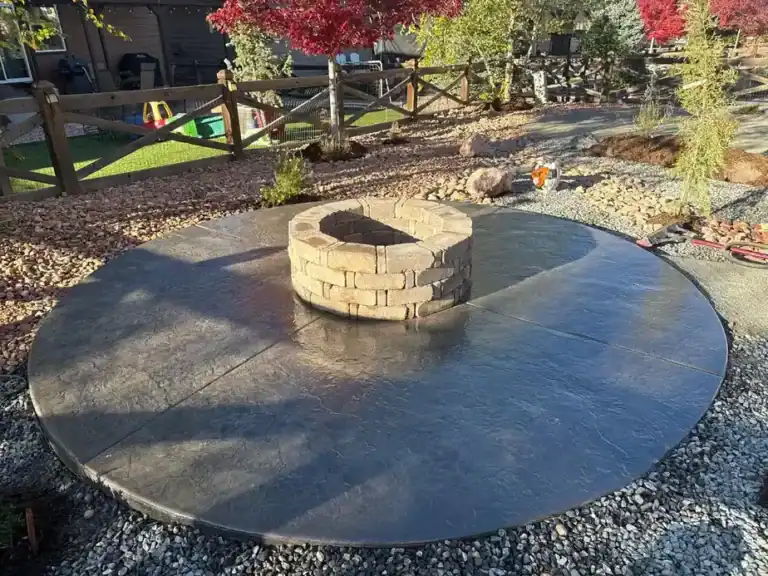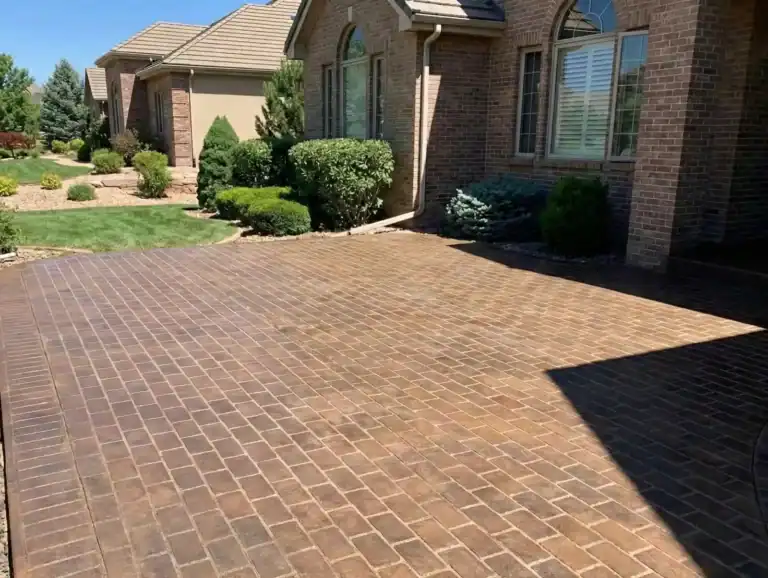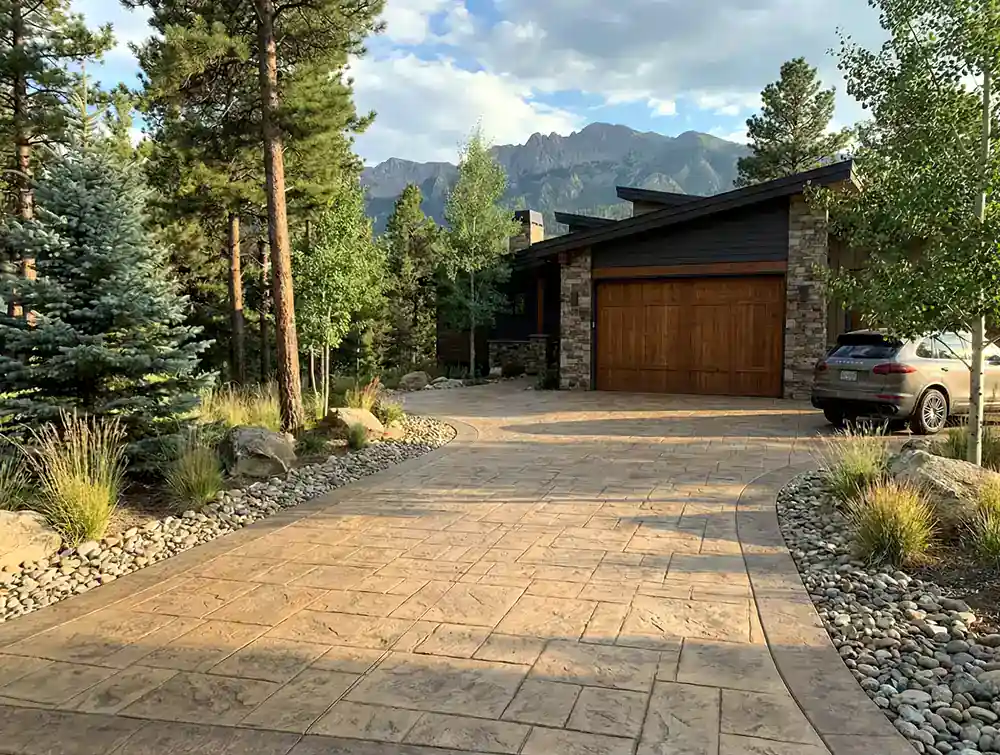
Stamped concrete is one of the most popular ways to upgrade a driveway, patio, or walkway in Colorado Springs. It gives you the look of natural stone, brick, or slate at a fraction of the cost of the real thing, and it holds up to the Front Range climate when it’s installed correctly. This guide covers what Colorado Springs homeowners need to know about stamped concrete: patterns, colors, cost, maintenance, and what to expect during installation.
Stamped concrete combines durability with design flexibility. You get one seamless slab that handles our freeze-thaw cycles and intense UV while looking like materials that cost two to three times more, with no joints for weeds, no pavers to shift, and no grout lines to crack.
What Is Stamped Concrete?
Stamped concrete is freshly poured concrete that’s colored and textured to resemble stone, brick, slate, or wood. After the concrete is poured and leveled, the crew presses large rubber mats (stamps) into the surface before it sets. Integral color mixed through the concrete plus a contrasting release agent on the surface creates the depth and color variation you see in natural materials.
Popular Stamped Concrete Patterns in Colorado Springs
Two patterns account for almost every stamped project we pour:
Ashlar Slate
The most requested pattern in Colorado Springs by a wide margin. Rectangular stone shapes in varying sizes with a slate texture. It’s clean, natural, and works with everything from modern homes in Briargate to ranch-style properties in Security-Widefield.
Roman Slate
The second most popular. A slate texture without the strong rectangular grid, so it reads as one continuous stone surface. It looks natural, hides minor variation well, and suits patios where you want texture without a busy pattern.
Other patterns exist (random flagstone, herringbone brick, European fan cobblestone, wood plank), but they’re rarely chosen, and the busier ones cost more because they take longer to lay out and detail. Ask to see completed ashlar and roman slate projects before looking further.
Stamped Concrete Colors That Work in Colorado
Stamped concrete uses two colors together: integral color mixed through the whole batch, and a darker release agent applied to the surface before stamping. In Colorado Springs, earth tones dominate because they blend with the landscape: tan or sandstone with a brown release for a warm, neutral look, or a gray base with a charcoal release for modern homes.
Integral color runs all the way through the slab, so a chip or worn spot doesn’t expose plain gray. Pigment is priced by the yard of concrete and varies a lot by color: earth tones are the most affordable, while dark grays and blacks use far more pigment and cost several times as much.
Lighter colors reflect more sun and stay cooler underfoot, which matters on patios and pool decks at our altitude. Darker colors hide dirt but absorb heat and cost more in pigment. Medium earth tones are the sweet spot. Ask for a cured sample, not a screen swatch; Colorado’s bright light changes how colors read.
How Much Does Stamped Concrete Cost in Colorado Springs?
Start with plain broom-finish concrete, which runs about $20 per square foot at a typical project size and drops toward $12-15 on large pours. Stamping adds integral color, release agent, the labor of pressing and detailing the pattern before the concrete sets, and a sealer coat after it cures. Stamped work commonly runs 1.25 to 2 times the plain-concrete price, with a single pattern in one earth tone at the low end and two-tone color work and borders at the high end. Every stamped project is quoted individually, and we price all projects at a $6,500 minimum.
- Stamped patio (400 sq ft): roughly $10,000 to $16,000. See our stamped concrete patio cost guide.
- Stamped two-car driveway (400-600 sq ft): roughly $10,000 to $24,000, plus about $2 per square foot if an old driveway comes out.
- Stamped walkway: A small pour, so the project minimum usually applies. Walkways are best poured together with a patio, steps, or driveway.
Pattern complexity, number of colors, project size, tear-out, and backyard access (a pump truck adds roughly $650-850) are what move the number. For comparison, natural flagstone typically runs $25-45 per square foot installed and pavers $18-35, and both come with joints to maintain.
Stamped Concrete Maintenance in Colorado
Stamped concrete is low maintenance, not no maintenance. Unlike plain grey concrete, which we tell customers not to seal, stamped work depends on its sealer.
Sealing
Sealer protects the color from UV fading, keeps moisture out of the surface, and deepens the color. The first coat is included in our stamped pricing and goes on about three weeks after the pour. Plan to reseal every 2-3 years in Colorado Springs. The easy test: splash water on the surface. If it soaks in instead of beading, it’s time.
Never use salt or chemical deicers on stamped concrete. They attack the surface and discolor it. Use sand for traction in winter. Deicer damage isn’t covered under any concrete warranty.
A garden hose or a low-pressure wash (under 1,500 PSI) is all it needs. Harsh chemicals and aggressive pressure washing strip the sealer. Clear wet leaves promptly in fall; they stain. Shovel snow with plastic, not metal.
How Long Does Stamped Concrete Last?
Properly built and resealed, stamped concrete lasts 25-30+ years in Colorado Springs. The slab is the same 4,000 PSI air-entrained concrete with fiber rebar as any quality pour; the pattern and color are part of the concrete, not a coating that wears off. The sealer is what gets renewed, like restaining a deck, except the structure under it lasts decades.
Stamped Concrete Installation: What to Expect
A typical stamped project takes two days of crew work, then curing and sealing.
Day One: Tear-Out, Grading, Forms, and Rebar
The old surface comes out if you’re replacing one. The ground is graded to drain and compacted; on most Colorado Springs lots the native ground is a good subgrade and no gravel base is needed. Forms are set to the exact grade and shape, and fiber rebar, composite bars that can’t rust, is tied into a grid.
Day Two: Pour, Color, and Stamp
Concrete arrives with the integral color already in the mix, first thing in the morning on hot days. It’s placed, screeded, and floated, then the colored release agent goes on and the stamp mats are pressed in while the slab is still workable. Timing is everything: the concrete has to be firm enough to hold the pattern and soft enough to take it, across the whole slab at once. That’s why a stamped pour gets a pump truck when the truck can’t reach it, never a line of wheelbarrows, and why the crew never runs extra hose water into the drum to make it easier to push. Both shortcuts leave you with uneven pattern depth and a two-tone slab.
Detail, Cure, and Seal
Edges are hand-detailed and control joints are cut the same day. The release agent is washed off a day or two later to reveal the two-tone color. Foot traffic is fine after 24-48 hours, vehicles after 7 days (14 is better), and full strength comes at 28 days. Sealer goes on about three weeks after the pour.
Stamped Concrete vs. Other Options
- vs. plain concrete: Stamped costs 1.25-2x more and needs resealing every 2-3 years. Plain grey needs nothing on a schedule. The difference in appearance is night and day.
- vs. pavers: Stamped is one seamless surface with no joints for weeds and no units to shift or settle. Pavers can be replaced individually; stamped repairs are harder to match. See our stamped concrete vs. pavers comparison.
- vs. natural stone: Stone costs two to three times more and needs joint maintenance. Stamped concrete gets very close in appearance, but it isn’t identical up close.
Common Stamped Concrete Questions
Will stamped concrete crack?
All concrete can develop hairline cracks. Grading and compacting the ground, fiber rebar in a tied grid, and control joints cut the same day keep cracking to a minimum and keep any crack tight. Hairlines are cosmetic and don’t affect the slab.
Can you stamp existing concrete?
Not once it’s cured. Stampable overlays exist, a thin layer applied over an old slab and stamped, but they’re not work we do, and in Colorado’s freeze-thaw climate they don’t last like a full-depth pour. If the old slab is failing, replace it.
Is stamped concrete slippery?
The texture gives more traction than smooth concrete, but a heavy coat of sealer can be slick when wet. A grip additive in the sealer solves that for pool decks, slopes, and steps.
What’s the best time of year for stamped concrete in Colorado Springs?
May through October. Concrete needs temperatures that stay above freezing for the first week. On hot days (90°F and up) we pour first thing in the morning so the slab doesn’t set up before the stamping is finished. See our guide to the best time to pour concrete in Colorado.
Can stamped concrete be repaired?
Minor surface repairs are possible, but matching color and pattern exactly is hard, which is why getting the pour right the first time matters so much. Major cracking or settling usually means replacing the affected panel.
Ready for a Stamped Concrete Project?
Get Your Free EstimateRelated: Stamped Concrete Services | Stamped Patio Cost Guide | Stamped Concrete vs Pavers | Concrete Patio Ideas for Colorado
Creststone Concrete serves homeowners throughout Colorado Springs, Monument, Castle Rock, Parker, Lone Tree, and the I-25 corridor with quality concrete driveways, patios, walkways, and decorative concrete. Call (719) 631-2660 or request a free estimate online.